
WhatsApp us on +91 9091913999 or Call us on +91 9811881981
When an Arbitral Award Meets Public Policy: Hong Kong Court Refuses Enforcement in K v JX
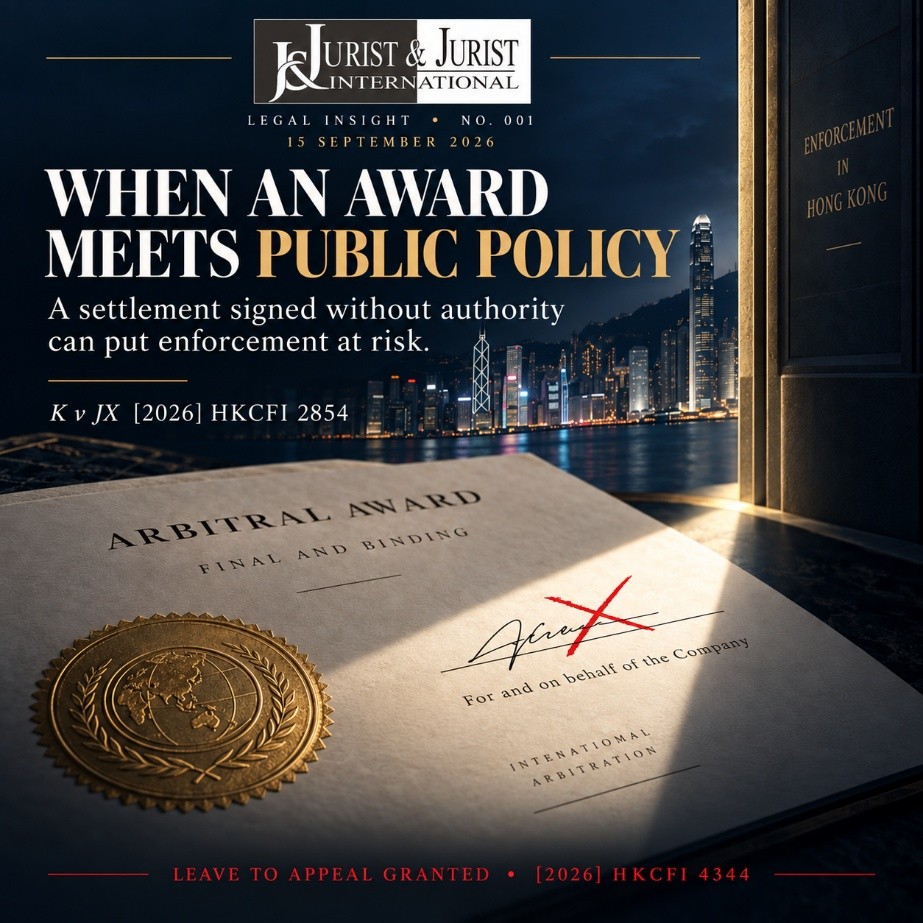
Legal Insight No. 001 | 15 September 2026
Jurist & Jurist International
Meta description: In K v JX [2026] HKCFI 2854, the Hong Kong Court refused enforcement of a Mainland arbitral award arising from a settlement signed without corporate authority. The case examines apparent authority, post-award evidence and the narrow public policy exception.
An arbitral tribunal had ordered a company to withdraw substantial Hong Kong court claims under a settlement agreement. The tribunal accepted that the person who signed for the company had apparent authority, and the award creditor obtained permission to enforce the award in Hong Kong.
The Hong Kong Court of First Instance nevertheless set aside that enforcement order in K v JX [2026] HKCFI 2854. It found that the signatory had acted without the company’s knowledge or authority and that the award creditor had no reasonable basis for believing otherwise. Enforcing an award that gave effect to the settlement would, in the Court’s assessment, be grossly unjust and contrary to Hong Kong public policy.
The case raises a question for cross-border businesses: how can a settlement that produces an arbitral award still create an enforcement risk? The answer lies in the authority behind the agreement, the circumstances known to the parties when it was signed, and the evidence available when enforcement is sought.
The dispute behind K v JX
The dispute began with a cooperation agreement for the development of land in Fuzhou. JX, a Mainland company, subsequently brought proceedings in Hong Kong against K and others, seeking substantial damages and, alternatively, loss of profits.
In January 2021, a settlement agreement was signed in the names of K and JX. Among its terms, JX was to discontinue its Hong Kong court action. The agreement was governed by PRC law and provided for disputes to be resolved by arbitration before the Beijing Arbitration Commission.
The individual who signed for JX, referred to in the reported decisions as C, was described as its “actual controller.” JX disputed that description. C had resigned before the settlement was signed and was neither JX’s director nor its legal representative. The agreement also bore JX’s old company seal.
JX did not discontinue its court action. K commenced arbitration to enforce the settlement. In November 2023, the tribunal ordered JX to withdraw the Hong Kong proceedings and pay K RMB 15 million, together with costs and arbitration expenses. K then obtained leave to enforce the award in Hong Kong. The Hong Kong Law Society’s case report and analysis of both decisions set out this procedural history.
Why did the tribunal accept the settlement?
The tribunal found no evidence that C had actual authority to act for JX or was its actual controller. It nonetheless concluded that K had reason to believe C was authorised.
A significant part of that conclusion concerned the company seal. The evidence before the tribunal indicated that JX had used its old and new seals concurrently. Applying the PRC-law principle of apparent authority, the tribunal held that C’s execution of the settlement bound JX.
Apparent authority matters where a person has not been expressly authorised but the circumstances give the counterparty a legally sufficient reason to believe that authority exists. In K v JX, the critical question at the Hong Kong enforcement stage became whether K and his representative truly had such a reason, given what they knew about the settlement and its signatory.
Two challenges to enforcement, with different outcomes
JX applied to set aside the Hong Kong enforcement order. It advanced two principal grounds: that there was no valid arbitration agreement, and that enforcement would be contrary to Hong Kong public policy.
The Court rejected the challenge to the arbitration agreement. An arbitration clause is legally distinct from the broader agreement containing it. JX had also submitted to the tribunal’s jurisdiction during the arbitration and had not then challenged the validity of the arbitration clause. The alleged invalidity of the settlement did not, in those circumstances, establish that the tribunal lacked jurisdiction.
The public policy objection required a separate inquiry. The Court had to decide whether it would be acceptable to enforce an award giving effect to a settlement allegedly made without JX’s authority and in circumstances involving serious allegations of collusion.
This distinction is central to the decision. A failed jurisdiction challenge did not automatically dispose of the enforcement-stage public policy challenge. The Hong Kong Law Society’s report records both holdings.
Why could the Hong Kong Court examine new evidence?
Courts generally approach the public policy exception narrowly. Enforcement proceedings are not an appeal from the tribunal’s decision, and a party cannot simply reargue an issue it lost in arbitration by attaching a public policy label to it.
The allegations in K v JX were different in an important respect. Evidence concerning alleged collusion and bribery had emerged after the award and had not been submitted to or determined by the tribunal. The Court considered that it could examine those serious allegations when deciding whether enforcement itself would offend public policy.
That did not mean accepting every new allegation at face value. C had provided affirmations concerning the settlement, but he did not attend the substantive hearing for cross-examination. The Court excluded his affirmations and assessed the remaining evidence, including oral testimony from other witnesses.
This part of the decision illustrates both sides of the public policy threshold: a court may examine serious post-award matters that the tribunal never considered, but the party resisting enforcement must still support its case with evidence capable of scrutiny. The case report describes the exclusion of C’s affirmations and the Court’s subsequent assessment.
Why did the Court find no reasonable basis for apparent authority?
The Court focused on what K and his representative, WP, knew—or should reasonably have appreciated—when the settlement was negotiated and signed.
This was an unusual and consequential agreement. It required JX to abandon substantial live court claims and contained terms concerning land compensation. It also dealt with C’s personal loans from project companies, indicating a possible personal interest in the settlement.
Against that background, the Court found that K and WP should have verified C’s position or asked for written proof of authority. WP was a lawyer by training and a risk-control director. Yet neither he nor K checked whether C was JX’s legal representative or director, or whether he had authority to compromise JX’s claims.
The Court concluded that K and WP had no reason to believe C was authorised. On its assessment, they had turned a blind eye to a question the circumstances plainly required them to investigate. C’s prior dealings and the use of an old company seal did not remove the need for inquiry in this significant settlement.
The Court found that the agreement had been made without JX’s knowledge or authority. Enforcing an award that required JX to withdraw its court action under that agreement would be contrary to fundamental conceptions of morality and justice. It therefore set aside the Hong Kong enforcement order on public policy grounds. The Hong Kong Law Society’s case report sets out the authority and public policy findings.
What happened on the application for leave to appeal?
K sought leave to appeal. In the follow-up decision, K v JX [2026] HKCFI 4344, the Court considered that K’s proposed grounds had no reasonable prospect of success. It nevertheless granted leave because its approach to refusing enforcement on public policy grounds raised a question of public interest appropriate for consideration by the Court of Appeal.
Leave to appeal is not an appeal judgment. The follow-up decision permits appellate consideration; it does not establish how the Court of Appeal will decide the issue. The grant of leave and the Court’s reasons are discussed in Reed Smith’s analysis of the two decisions.
What should cross-border businesses learn from the case?
The immediate lesson concerns settlement authority. A settlement may change the course of major litigation, allocate valuable commercial rights and become the foundation of an arbitral award. Parties should therefore know who can bind the company before execution, especially when the signatory is neither a director nor the recognised legal representative.
A practical authority check may include confirming the signatory’s current corporate role, obtaining written authorisation where needed, and retaining the documents and communications on which the counterparty relied. Where the terms are unusual or suggest a personal conflict of interest, the need to make and record those inquiries becomes more acute.
The decision also matters for arbitral award enforcement strategy. Parties should assess whether the settlement and its execution can withstand scrutiny in a jurisdiction where enforcement may later be sought. Conversely, a party resisting enforcement cannot assume that an allegation of wrongdoing will reopen the arbitration: the public policy ground remains narrow, and the evidence must be examined carefully.
Our takeaway
In cross-border settlements, verify and document the signatory’s authority before signing—because an arbitral award may still face an enforcement challenge if the settlement was made without authority.
K v JX does not establish that every disputed signature defeats an award. It demonstrates the risk where a settlement has major consequences, the surrounding circumstances call for an authority check, and the party relying on apparent authority proceeds without making one.
Sources: Hong Kong Law Society case report — K v JX [2026] HKCFI 2854; analysis of K v JX [2026] HKCFI 2854 and [2026] HKCFI 4344
Copyright © 2012-2025. Jurist & Jurist International is a registered trademark. Unauthorized use, reproduction, or imitation of our name, logo, or design is strictly prohibited and punishable under applicable laws.
Designed by RICKYTECH & CO.