
WhatsApp us on +91 9091913999 or Call us on +91 9811881981
U.S. Appeals Court Rejects Rapid Third-Country Deportation Policy: Due Process Before Removal
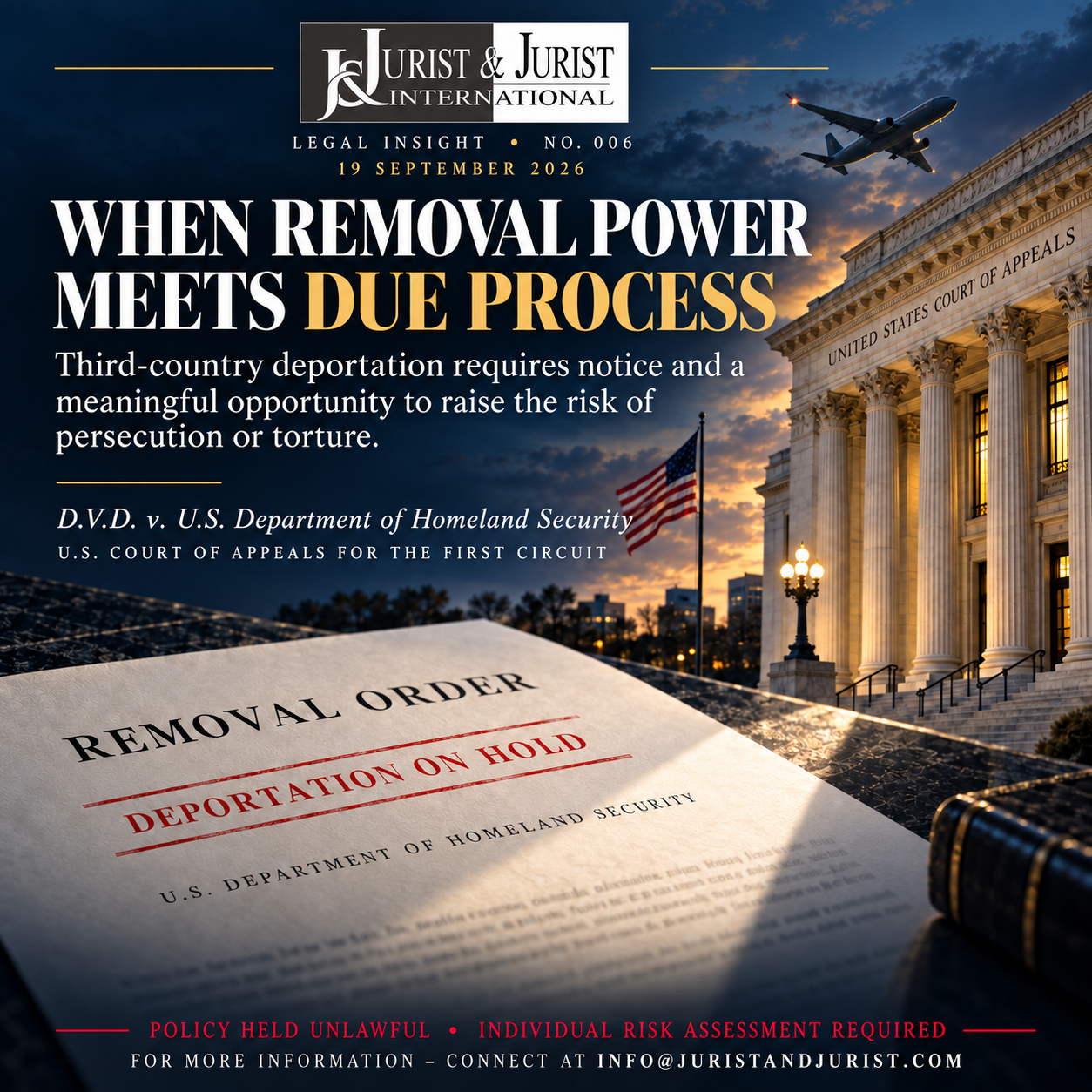
A government may possess the legal authority to remove a non-citizen, but that authority does not necessarily permit removal to any country without notice, examination of the risks involved, or an opportunity to be heard.
This distinction lies at the heart of the decision of the United States Court of Appeals for the First Circuit in D.V.D. v. U.S. Department of Homeland Security. On 18 September 2026, the appellate court largely upheld a lower-court judgment that had declared unlawful a policy allowing the rapid removal of individuals to third countries without providing them a meaningful opportunity to raise country-specific fears of persecution or torture.
The judgment does not create an absolute prohibition against third-country deportation. It instead addresses the process that must precede such removal. A final removal order may authorise the government to remove an individual from the United States, but it does not automatically resolve whether that individual can lawfully be sent to a previously unidentified country where separate and potentially serious risks may arise.
The decision is therefore significant beyond U.S. immigration law. It concerns the relationship between executive power, procedural fairness and the international prohibition against returning a person to persecution or torture.
What Is Third-Country Deportation?
Ordinarily, a person subject to removal proceedings is expected to be returned to the country identified during those proceedings, commonly the person’s country of nationality or another country having an established connection with that individual.
A third-country deportation occurs when the person is instead removed to a different country. The receiving country may not be the person’s country of origin, may not have been examined during the original proceedings and may have no meaningful personal connection with that individual.
Third-country removal may be considered where the country of origin refuses to accept the person, where travel documents cannot be secured, or where the person has obtained legal protection against return to that country because of a risk of persecution or torture.
The fact that a person cannot lawfully be returned to one country does not necessarily confer a right to remain permanently in the United States. U.S. law permits removal to another country in appropriate circumstances. The central issue in D.V.D.was whether the government could select such a destination and execute removal without providing a meaningful procedure through which the affected person could contest the dangers associated with that new destination.
The Department of Homeland Security Policy
The U.S. Department of Homeland Security adopted the disputed policy in March 2025. It was directed, in part, towards individuals already subject to final removal orders, including persons who had obtained protection against return to their home countries.
Under the policy, removal to an alternative country could proceed where the authorities considered that reliable diplomatic assurances had been received that the person would not be persecuted or tortured in the receiving country.
Where such assurances were not available, the policy contemplated limited notice before removal. According to reporting on the litigation, an affected person could, in some circumstances, receive as little as six hours’ notice of the proposed destination.
That approach created a practical and legal difficulty. A person cannot meaningfully establish a danger of persecution or torture without knowing the country to which removal is proposed. Even after receiving that information, the person may need access to legal advice, country-condition evidence, personal records and an adjudicatory process capable of examining the claimed risk.
A procedure that supplies only the name of the destination moments before departure may provide notice in a literal sense, while denying it any effective legal value.
The Litigation in D.V.D. v. Department of Homeland Security
The proceedings were brought as a class action on behalf of individuals subject to final removal orders who faced possible removal to countries not identified during their immigration proceedings.
In the earlier stages of the litigation, the federal district court imposed protections requiring notice and an opportunity to present claims against removal to a proposed third country. The litigation subsequently reached the U.S. Supreme Court through emergency applications concerning interim relief. The Supreme Court stayed aspects of the preliminary injunction while the underlying appeal continued. Those emergency orders did not constitute a final determination of the merits of the entire dispute.
In February 2026, U.S. District Judge Brian Murphy set aside the Department of Homeland Security policy. The district court concluded that the policy did not adequately protect the rights of affected individuals and created a danger of removal to unfamiliar and potentially unsafe countries without sufficient notice or opportunity to object.
The government appealed. In March 2026, the First Circuit stayed the lower court’s decision while the appeal was pending. The appellate court subsequently considered the substantive legality of the policy and delivered its decision on 18 September 2026.
The First Circuit largely upheld the conclusion that the policy was unlawful. Judge Seth Aframe, writing for the panel, treated the immigration legislation as requiring a meaningful opportunity to seek the protection that Congress had made available against persecution and torture.
The Court rejected an interpretation under which individuals could effectively lose access to those protections simply because the government selected a new destination at the stage of executing the removal order.
The Legal Framework Governing Removal
The case sits at the intersection of three related but distinct legal questions:
- Which countries may the government select for removal?
- When must removal be withheld because of threatened persecution?
- What protection applies where the person is likely to face torture?
Selection of the Country of Removal
Section 241(b) of the Immigration and Nationality Act, codified at 8 U.S.C. § 1231(b), establishes a sequence through which the government may determine the country of removal.
The statutory framework gives immigration authorities considerable power to identify an appropriate destination. That power, however, operates alongside specific restrictions designed to prevent removal to persecution or torture.
Authority to select a country is therefore not the same as authority to ignore the legal consequences of conditions in that country.
Protection Against Persecution
Section 241(b)(3) restricts removal to a country where the individual’s life or freedom would be threatened because of race, religion, nationality, membership of a particular social group or political opinion.
This protection is destination-specific. A finding that an individual faces persecution in one country does not automatically establish the same risk in every other country. Conversely, protection against return to the country of origin cannot answer whether the individual faces a different danger in a newly selected third country.
A lawful system must therefore permit the person to raise a claim concerning the actual country proposed for removal.
Protection Under the Convention Against Torture
The United States is a party to the United Nations Convention Against Torture and Other Cruel, Inhuman or Degrading Treatment or Punishment. Article 3 embodies the prohibition against sending a person toa state where there are substantial grounds for believing that the person would be in danger of torture.
The United States implemented its obligations through domestic legislation and regulations. Under 8 C.F.R. § 1208.16, an applicant seeking protection must ordinarily establish that it is more likely than not that the person would be tortured in the proposed country of removal.
The assessment may include:
- Evidence of past torture;
- The possibility of safe relocation within the proposed country;
- Evidence of gross, flagrant or widespread human-rights violations; and
- Other relevant information concerning conditions in that country.
Where the applicable standard is satisfied, protection may take the form of withholding or deferral of removal. Importantly, such relief protects against removal to the country presenting the relevant danger; it does not necessarily prevent removal to every other country.
This country-specific character of the protection explains why advance identification of the destination is essential. Without knowledge of the proposed country, the affected person cannot collect evidence or meaningfully invoke the legal test.
Why Notice Alone Is Not Sufficient
The First Circuit’s reasoning is important because it distinguishes formal notice from a meaningful opportunity to be heard.
A notice issued shortly before departure may communicate the name of the country, but it may not provide sufficient time to:
- Contact legal counsel;
- Obtain information about conditions in the destination country;
- Explain personal, political, religious or social circumstances creating a particular risk;
- Secure evidence of previous threats or mistreatment;
- Obtain translation or interpretation assistance; or
- Present the claim before a competent decision-maker.
Where the potential consequence is persecution, torture or another form of irreparable harm, a procedure must be capable of preventing the removal before it occurs. A remedy available only after the person has been transferred may be practically ineffective.
The judgment does not prescribe that every objection must succeed. It requires an effective opportunity to present the objection and obtain a lawful determination before removal.
Diplomatic Assurances and Individual Risk Assessment
The policy also relied upon diplomatic assurances from receiving countries.
Diplomatic assurances may form part of the government’s assessment of whether removal would expose an individual to prohibited treatment. U.S. regulations expressly recognise a process for considering assurances against torture. However, the existence of an assurance does not necessarily answer every question.
Its reliability may depend upon:
- The human-rights record of the receiving state;
- The clarity and specificity of the assurance;
- Whether the assurance addresses the individual circumstances of the person;
- The receiving state’s ability and willingness to comply;
- The existence of independent monitoring;
- Access to legal representatives after transfer; and
- The consequences of any breach.
A general statement that a person will be treated safely cannot always substitute for examination of a specific claim based on political affiliation, religion, ethnicity, sexual orientation, previous detention, organised violence or other individual circumstances.
The deeper concern is not that diplomatic assurances are legally irrelevant. It is that they should not become an automatic substitute for an individual risk assessment where credible evidence points towards persecution or torture.
What the First Circuit Actually Decided
The decision must be understood with precision.
The First Circuit did not hold that the United States lacks authority to remove a person to a third country. Nor did it decide that every person subject to a final removal order is entitled to remain in the United States.
The Court instead concluded that the government could not administer third-country removals in a manner that deprived a substantial group of non-citizens of a meaningful opportunity to invoke existing statutory and regulatory protections.
The operative distinction is between:
- The authority to remove a person from the United States; and
- The legality of removing that person to a particular destination.
A final removal order principally resolves the first question. Where the government later selects a country that was not considered during the proceedings, the second question may require a new and destination-specific assessment.
The Part of the Lower-Court Decision That Was Reversed
Although the First Circuit largely upheld the lower court’s decision, it did not affirm every aspect of it.
The appellate court reversed, on procedural grounds, the portion dealing with whether the government must first attempt removal to a designated country, a country of nationality or another country connected with the individual before resorting to an unrelated third country.
This limitation is important. It demonstrates that the appellate court did not endorse the entire remedial structure imposed below.
The judgment protects access to the legal process for raising country-specific danger. It should not be read as establishing an inflexible rule that third-country removal is permissible only after every connected country has been approached and rejected the person.
Non-Refoulement and the Wider International-Law Context
The principle of non-refoulement generally prohibits transferring a person to a place where the person faces specified forms of serious harm. Its precise scope and legal source may differ depending upon whether the claim concerns refugeeprotection, torture, human rights law or domestic legislation.
In the present context, protection against torture is especially significant because it is not merely a discretionary humanitarian consideration. The applicable legal framework requires an assessment of whether the person is more likely than not to be tortured in the proposed country of removal.
The D.V.D.decision reflects a basic feature of non-refoulement: the protection must operate before transfer. Once a person has been removed into the custody or territory of another state, physical return, access to counsel and effective judicial intervention may become substantially more difficult.
Non-refoulement therefore depends upon both substantive and procedural safeguards. The substantive rule identifies the prohibited danger. The procedural safeguard ensures that the danger can be identified before it is too late.
Why the Decision Matters Beyond the United States
Third-country arrangements are becoming increasingly important in global migration policy. Governments may seek agreements under which another state accepts persons who are not its nationals and may have no previous connection with it.
Such arrangements are often defended as necessary to address difficulties in executing removal orders, discourage irregular migration or distribute responsibility between states. Critics argue that they can relocate governmental responsibility to jurisdictions with weaker institutions, reduced transparency or limited access to legal remedies.
The First Circuit’s decision does not resolve the global debate over externalised migration control. It does, however, identify a principle relevant to every such arrangement:
The legality of a transfer depends not only upon the existence of an agreement between governments, but also upon the treatment of the individual whose life and liberty may be affected.
An intergovernmental arrangement cannot, by itself, determine whether a particular individual will be safe. That requires examination of the destination, the person’s circumstances and the reliability of the protections offered.
Reported Scale of Third-Country Removals
Reuters reported, by reference to the Third Country Deportation Watch project, that more than 25,000 migrants had been sent to at least 29 third countries under arrangements pursued by the administration. The reported destinations included Mexico and several African states.
This figure was attributed to an external monitoring project and should not be confused with a factual finding made by the First Circuit.
The reported scale nevertheless explains the institutional importance of the dispute. The litigation does not concern only an isolated removal decision. It addresses the legality of a policy capable of affecting thousands of people whose original proceedings may never have examined conditions in the countries subsequently selected for them.
Present Legal Position and Possible Further Appeal
At the time the appellate decision was reported, the Department of Homeland Security maintained that the policy remained operational because the First Circuit’s judgment had not yet taken effect.
The government is expected to seek further review. The case may therefore return to the U.S. Supreme Court, which previously considered emergency applications arising from the preliminary stages of the litigation.
Any further proceedings will need to distinguish carefully between interim orders and a final determination on the merits. A stay may temporarily suspend the operation of a lower-court order without deciding whether the challenged policy is ultimately lawful.
Until the appellate process is concluded, the legal position may remain affected by the timing of the mandate, any application for rehearing, further stay orders and a possible petition to the Supreme Court.
Practical Implications of the Judgment
For immigration authorities, the decision indicates that operational efficiency cannot be achieved by eliminating the procedure necessary to test a claim of persecution or torture.
For affected individuals and their representatives, the judgment emphasises the importance of:
- Obtaining written confirmation of the proposed destination;
- Documenting the time and manner in which notice was given;
- Raising destination-specific objections immediately;
- Preserving evidence of personal risk and relevant country conditions;
- Challenging the adequacy and reliability of diplomatic assurances where appropriate; and
- Seeking relief before physical removal takes place.
For governments negotiating third-country arrangements, the decision highlights the need for transparent procedures, reliable safety assessments, access to legal remedies and mechanisms for monitoring compliance after transfer.
A Judgment About the Rule of Law, Not Open Borders
The decision should not be reduced to a political choice between immigration enforcement and unrestricted entry.
The Court did not prevent the government from enforcing valid removal orders. It required the government to exercise that power consistently with protections enacted by Congress and the legal framework implementing the Convention Against Torture.
That distinction is essential. The rule of law does not exist only to determine whether the state possesses power. It also governs how that power must be exercised.
An effective immigration system may require the timely execution of lawful removal orders. An effective legal system must also ensure that administrative speed does not expose a person to persecution, torture or irreversible harm without a meaningful opportunity to present the danger.
Conclusion
D.V.D. v. U.S. Department of Homeland Securityestablishes an important boundary between the government’s authority to remove and its obligation to assess the lawfulness of the proposed destination.
The judgment does not eliminate third-country deportation. It rejects a process in which a new destination can be selected and removal rapidly executed without giving the affected person a realistic opportunity to raise country-specific risks.
Its central lesson is straightforward:
A protection against persecution or torture has little meaning unless the person knows the proposed destination and can invoke that protection before removal occurs.
As governments increasingly rely upon third-country arrangements, courts are likely to face further questions concerning diplomatic assurances, access to legal representation, adequacy of notice and the extent of individual risk assessment required before transfer.
The First Circuit’s decision confirms that migration control may remain an exercise of sovereign authority, but its exercise is subject to law. Where removal may expose a person to persecution or torture, procedural fairness is not an administrative formality. It is the mechanism through which the protection becomes real.
References
- S. Court of Appeals decision reported by Reuters, 18 September 2026
- 8 U.S.C. 1231—Detention and removal of persons ordered removed
- 8 C.F.R. Part 1208—Asylum, withholding and Convention Against Torture protection
- 8 C.F.R. 1208.16—Withholding of removal and protection under the Convention Against Torture
This article is intended for legal education and general information. It does not constitute advice on any individual immigration or removal proceeding.
Copyright © 2012-2025. Jurist & Jurist International is a registered trademark. Unauthorized use, reproduction, or imitation of our name, logo, or design is strictly prohibited and punishable under applicable laws.
Designed by RICKYTECH & CO.