
WhatsApp us on +91 9091913999 or Call us on +91 9811881981
WHEN AN OPT-OUT FROM ADJUDICATION STILL LEADS TO COMPULSORY CONCILIATION
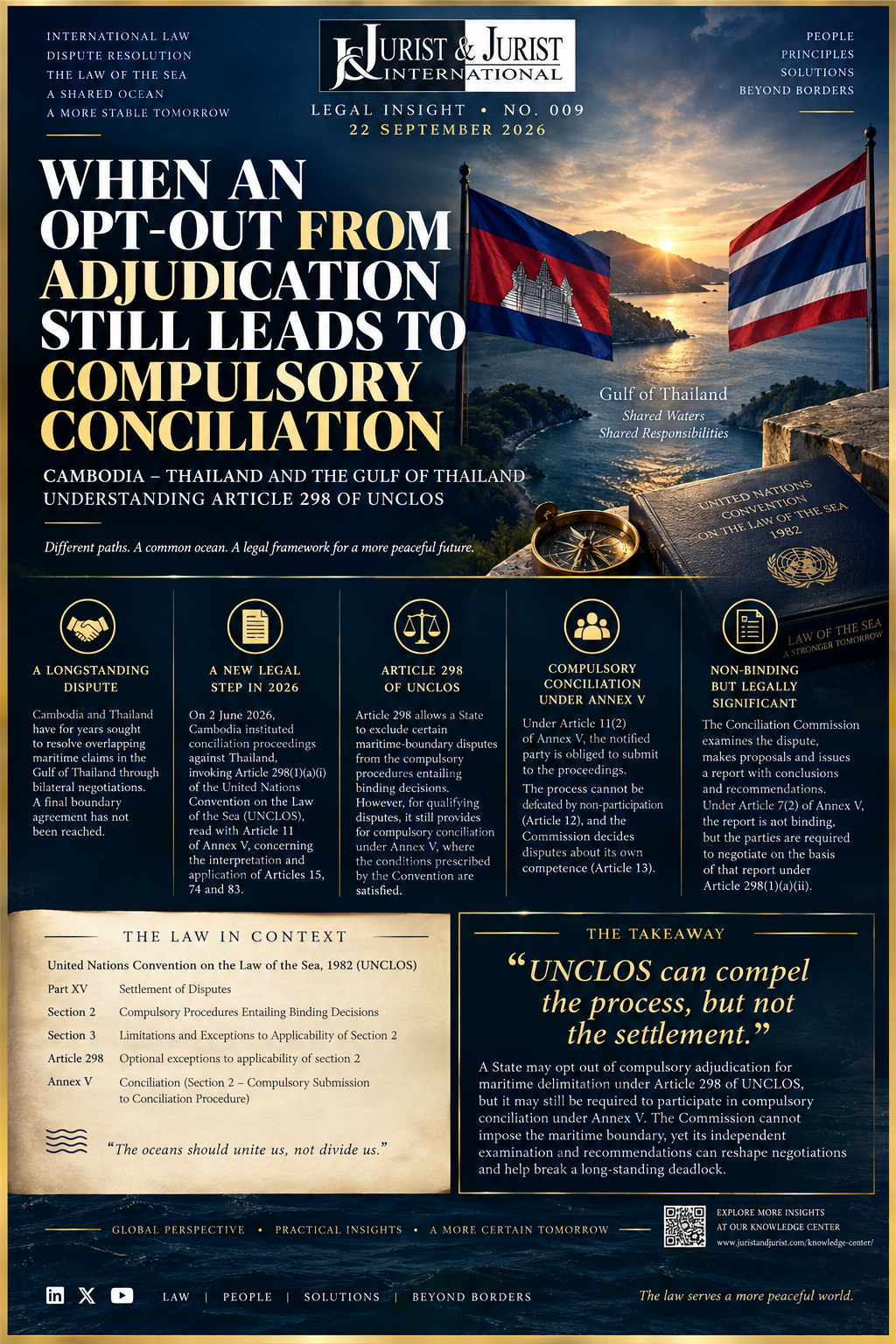
Legal Insight No. 009 | 22 September 2026
Jurist & Jurist International
WHEN AN OPT-OUT FROM ADJUDICATION STILL LEADS TO COMPULSORY CONCILIATION
Cambodia-Thailand and the Gulf of Thailand: Understanding Article 298 of UNCLOS
International dispute settlement is built fundamentally upon State consent. A State is ordinarily not subjected to the jurisdiction of an international court or tribunal unless it has accepted that jurisdiction, whether by treaty, declaration or specific agreement. The ongoing maritime dispute between Cambodia and Thailand, however, presents an important illustration of how that consent can operate in a more sophisticated manner under the United Nations Convention on the Law of the Sea, 1982 (“UNCLOS”).
For years, Cambodia and Thailand have faced unresolved questions concerning their maritime boundary in the Gulf of Thailand. Bilateral negotiations did not produce a final delimitation agreement. The dispute acquired a new legal dimension in 2026 when Cambodia turned to the dispute-settlement machinery contained in UNCLOS.
On 2 June 2026, Cambodia served a Notification Instituting Conciliation against Thailand. Cambodia invoked Article 298(1)(a)(i) of UNCLOS, read with Article 11 of Annex V to UNCLOS, in relation to a dispute concerning Articles 15, 74 and 83 of UNCLOS. The legal basis chosen by Cambodia is what makes the proceeding particularly significant.
At first sight, Article 298 may appear an unusual provision for a State seeking to commence an international proceeding, because Article 298 is an exception to compulsory adjudication. To understand the apparent contradiction, it is necessary to look at the architecture of UNCLOS.
UNCLOS does not merely regulate territorial seas, exclusive economic zones, continental shelves and navigation. Part XV of the Convention establishes a detailed regime for the settlement of disputes concerning the interpretation or application of UNCLOS. Within Part XV, Section 2 is titled “Compulsory Procedures Entailing Binding Decisions.” Subject to jurisdictional requirements and limitations, it creates routes through which disputes may be submitted to bodies such as the International Tribunal for the Law of the Sea, the International Court of Justice, an Annex VII arbitral tribunal or an Annex VIII special arbitral tribunal.
UNCLOS, however, recognises that certain disputes are especially sensitive for States. Maritime boundaries are among them. For that reason, Part XV, Section 3 of UNCLOS – “Limitations and Exceptions to Applicability of Section 2” – contains Article 298, formally titled “Optional exceptions to applicability of section 2.” Under Article 298(1)(a)(i), a State may declare that it does not accept the compulsory binding procedures of Section 2 for specified disputes concerning the interpretation or application of Articles 15, 74 and 83 relating to sea-boundary delimitation, as well as disputes involving historic bays or titles.
Article 15 of UNCLOS concerns delimitation of the territorial sea between States whose coasts are opposite or adjacent. Article 74 of UNCLOS deals with delimitation of the exclusive economic zone and requires delimitation by agreement on the basis of international law in order to achieve an equitable solution. Article 83 of UNCLOS applies substantially the same standard to delimitation of the continental shelf.
One might therefore expect the matter to end there: if a State has excluded maritime delimitation from compulsory binding dispute settlement, how can another State compel it to enter an international proceeding concerning maritime delimitation? The answer lies within Article 298 itself.
For qualifying sea-boundary disputes, Article 298(1)(a)(i) provides that where the conditions prescribed by the Convention are satisfied, including where no agreement has been reached within a reasonable period of negotiations, the State concerned shall, at the request of another party to the dispute, accept submission of the matter to conciliation under Section 2 of Annex V to UNCLOS.
A State may therefore be able to exclude a qualifying maritime-boundary dispute from a compulsory procedure resulting in a binding decision, but it does not necessarily acquire a right to exclude that dispute from every compulsory third-party process. UNCLOS replaces one form of dispute settlement with another: binding adjudication gives way to compulsory conciliation.
The next question is what makes this conciliation “compulsory”. Annex V to UNCLOS governs conciliation. Section 2 of Annex V is expressly concerned with “Compulsory Submission to Conciliation Procedure Pursuant to Section 3 of Part XV.” Under Article 11(1) of Annex V, a party entitled to invoke the procedure may institute conciliation by written notification addressed to the other party. Article 11(2) then supplies the essential element of compulsion: the party receiving the notification is obliged to submit to the proceedings.
The Convention also anticipates a situation in which a State chooses not to engage. Under Article 12 of Annex V, failure to reply to the notification or failure to submit to the proceedings does not prevent the proceedings from continuing. If a dispute arises as to whether the Conciliation Commission is competent to consider the matter, Article 13 of Annex V provides that the Commission itself decides that question.
This is therefore quite different from an ordinary diplomatic mediation in which either State may simply decline the invitation and thereby prevent the process from beginning. The consent underlying compulsory conciliation has already been given at treaty level through UNCLOS. Yet UNCLOS stops short of turning the conciliators into judges.
Through Article 14 of Annex V, relevant provisions governing the general conciliation procedure also apply to compulsory conciliation. Under Article 6 of Annex V, the Commission hears the parties, examines their claims and objections and makes proposals with a view to reaching an amicable settlement. If no settlement is achieved, Article 7 provides for a report recording the Commission’s conclusions on questions of fact or law relevant to the dispute and any recommendations it considers appropriate for an amicable settlement.
Article 7(2), however, draws a clear boundary around the Commission’s authority: its report, including its conclusions and recommendations, is not binding upon the parties. This produces the feature that makes the UNCLOS mechanism particularly important: a State may be compelled to participate in the process, but it cannot be compelled by the Conciliation Commission to accept the proposed settlement.
Even the Commission’s non-binding report is not intended simply to be filed away. Under Article 298(1)(a)(ii) of UNCLOS, once the Conciliation Commission has presented its reasoned report, the parties are required to negotiate an agreement on the basis of that report. If agreement still cannot be achieved, Article 298 contemplates resort to procedures producing a binding decision by mutual consent, unless the States otherwise agree.
Compulsory conciliation therefore does not replace diplomacy. It attempts to restructure failed diplomacy through law. The States first negotiate directly; if the Convention’s requirements are met, compulsory conciliation may intervene; the Commission examines the dispute and seeks an amicable settlement; and if settlement remains impossible, it produces a reasoned report that becomes the basis for renewed negotiations.
There is nevertheless an important boundary to this mechanism. Article 298(1)(a)(i) excludes from compulsory conciliation a sea-boundary dispute that necessarily involves the concurrent consideration of an unsettled dispute concerning sovereignty or other rights over continental or insular land territory. Maritime entitlement flows from land territory, but jurisdiction to consider maritime delimitation does not automatically carry jurisdiction to determine unresolved territorial sovereignty.
Against this legal background, the procedural developments in the Gulf of Thailand Conciliation become more significant. Cambodia instituted proceedings on 2 June 2026. Thailand submitted its Response on 19 June 2026. A five-member Conciliation Commission was subsequently constituted, with the Permanent Court of Arbitration acting as Registry. Although the proceeding appears on the PCA’s case docket, it is not a PCA arbitration. The PCA is administering the proceeding as Registry; the body considering the matter is the Conciliation Commission, and it will not issue an arbitral award.
The Commission held its first meeting with Cambodia and Thailand in Singapore from 14 to 16 September 2026, and its Rules of Procedure were adopted on 16 September 2026. The proceeding remains pending. There has been no determination of the maritime boundary and no final report or recommendation by the Commission.
The case therefore remains important not because international law has already supplied an answer to the Cambodia-Thailand maritime boundary, but because of the legal process through which the States are now required to confront the dispute. Article 298 of UNCLOS is more nuanced than an ordinary jurisdictional “opt-out”: it permits States to protect particularly sensitive categories of disputes from compulsory binding adjudication, while preserving a compulsory mechanism intended to prevent diplomatic deadlock from becoming permanent.
THE TAKEAWAY
The Gulf of Thailand Conciliation highlights an important but often overlooked distinction in the dispute-settlement framework of UNCLOS.
Under Article 298(1)(a)(i) of UNCLOS, a State may exclude certain disputes concerning maritime delimitation under Articles 15, 74 and 83 from the compulsory procedures that result in a binding decision. However, where the conditions prescribed by Article 298 are satisfied, that exclusion does not necessarily prevent compulsory conciliation under Section 2 of Annex V to UNCLOS.
The practical legal position is therefore clear: a State may reserve its right not to have a maritime boundary imposed upon it through compulsory adjudication, but it may still be required to participate in a treaty-based conciliation process aimed at resolving that same dispute.
The Conciliation Commission may examine the parties’ claims, consider relevant questions of fact and law, facilitate settlement and ultimately issue conclusions and recommendations. Those recommendations are not binding, and the Commission cannot itself impose the maritime boundary.
UNCLOS can compel the process, but not the settlement.
The Cambodia-Thailand proceeding therefore demonstrates how international law attempts to break a prolonged maritime negotiating deadlock without displacing State consent over the final boundary. Article 298 and Annex V provide a distinct route between ordinary diplomatic negotiation and binding international adjudication: compulsory engagement, independent examination and structured negotiation, while leaving the final settlement to the States themselves.
Source
Permanent Court of Arbitration, Gulf of Thailand Conciliation (Kingdom of Cambodia / Kingdom of Thailand), PCA Case No. 2026-35; United Nations Convention on the Law of the Sea, 1982, Part XV, Article 298 and Annex V.
JURIST & JURIST INTERNATIONAL LAW FIRM
International Law | Cross-Border Disputes | Arbitration & ADR
Copyright © 2012-2025. Jurist & Jurist International is a registered trademark. Unauthorized use, reproduction, or imitation of our name, logo, or design is strictly prohibited and punishable under applicable laws.
Designed by RICKYTECH & CO.