
Can a POCSO Case Be Quashed After a Compromise? Delhi High Court Draws a Clear Line
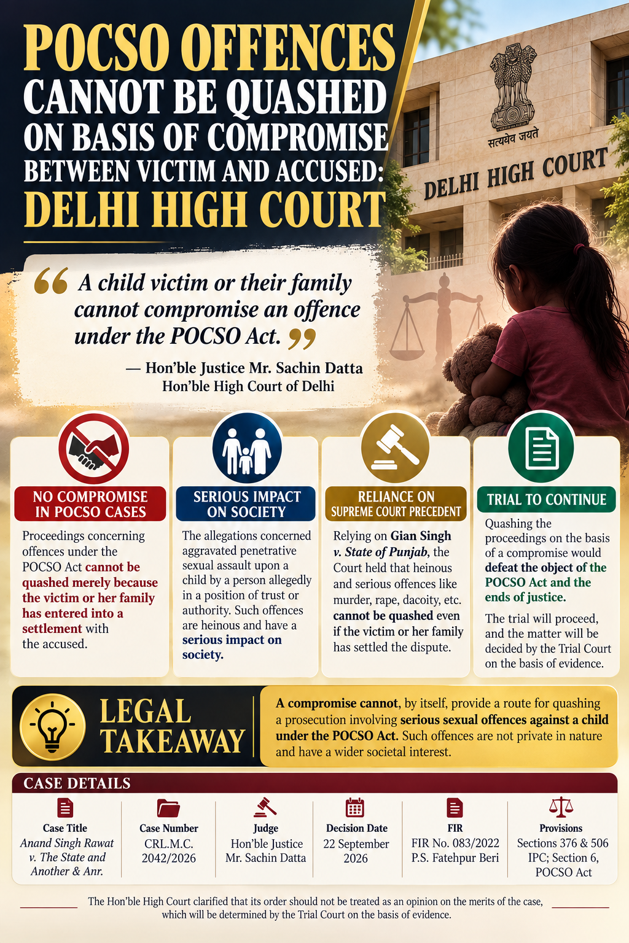
Anand Singh Rawat v. The State and Another & Anr. | 2026:DHC:8211 | Hon’ble High Court of Delhi | 22 September 2026
Can a settlement between an accused and the family of a child victim bring criminal proceedings under the Protection of Children from Sexual Offences Act, 2012 (“POCSO Act”) to an end?
The Hon’ble High Court of Delhi has answered this question in clear terms: a child victim or the child’s family cannot compromise an offence under the POCSO Act, and criminal proceedings involving such offences cannot be quashed merely because the parties have subsequently arrived at a settlement.
In Anand Singh Rawat v. The State and Another & Anr., Hon’ble Justice Mr. Sachin Datta refused to quash criminal proceedings involving allegations under Sections 376 and 506 of the Indian Penal Code, 1860 (“IPC”) and Section 6 of the POCSO Act, holding that permitting a compromise to terminate such proceedings would defeat both the object of the POCSO Act and the ends of justice.
The Case Before the Hon’ble High Court of Delhi
The petitioner, aged about 49 years, approached the Hon’ble High Court of Delhi seeking quashing of FIR No. 083/2022, Police Station Fatehpur Beri, registered under Sections 376 and 506 IPC and Section 6 of the POCSO Act.
The basis for seeking quashing was a compromise stated to have been reached with the victim through the intervention of her family.
Importantly, the criminal case was not at a preliminary stage. The Trial Court proceedings had already reached the stage of prosecution evidence.
The Court was therefore confronted with a significant question: Can the inherent jurisdiction of the High Court be invoked to terminate a prosecution involving serious sexual offences against a child merely because the parties have settled their dispute?
Why Section 6 of the POCSO Act Matters
The nature of the alleged offence was central to the Court’s decision.
The allegations concerned aggravated penetrative sexual assault upon a child by a person alleged to be in a position of trust or authority. The Court characterised the alleged offences as heinous offences having a serious impact upon society.
Section 6 of the POCSO Act provides punishment for aggravated penetrative sexual assault, making the nature of the alleged conduct materially different from an ordinary private dispute between two individuals.
This distinction ultimately became crucial to the Court’s consideration of whether settlement could justify exercise of its inherent jurisdiction.
Section 482 CrPC: A Wide Power, But Not an Unlimited One
The petition invoked the High Court’s inherent jurisdiction under Section 482 of the Code of Criminal Procedure, 1973.
Section 482 preserves the inherent powers of the High Court to make orders necessary to give effect to an order under the Code, prevent abuse of the process of any Court, or otherwise secure the ends of justice.
This jurisdiction is wider than the statutory mechanism for compounding offences under Section 320 CrPC. Consequently, in appropriate cases, the High Court may quash even proceedings relating to offences which are technically non-compoundable where the parties have genuinely resolved the underlying dispute.
But that power is not exercised mechanically merely because a settlement exists. The nature and gravity of the alleged offence remain fundamental considerations.
The Supreme Court’s Gian Singh Principle
The Hon’ble High Court of Delhi placed specific reliance on the Supreme Court’s landmark decision in Gian Singh v. State of Punjab, (2012) 10 SCC 303.
In Gian Singh, the Supreme Court recognised the distinction between the statutory power to compound an offence under Section 320 CrPC and the High Court’s inherent power to quash criminal proceedings under Section 482.
At the same time, the Supreme Court made it clear that the High Court must consider the nature and gravity of the crime before terminating criminal proceedings on the strength of a settlement.
The Delhi High Court particularly relied upon the principle that serious offences such as murder, rape and dacoity cannot ordinarily be treated as private disputes capable of being extinguished merely through settlement between the offender and victim or the victim’s family. The underlying reason is that certain offences extend beyond the immediate individuals involved and have a serious societal dimension.
Why a POCSO Offence Cannot Become a Private Settlement
Applying the principles of Gian Singh, the Hon’ble High Court of Delhi held that the allegations before it concerned heinous offences having a serious impact upon society.
“A settlement between the victim and the offender in such cases has no legal sanction.”
The judgment therefore draws an important distinction between settlement of a private dispute and an attempt to settle an offence in which the criminal law recognises a wider societal interest.
The POCSO Act is a special protective legislation enacted specifically to protect children from sexual assault, sexual harassment and pornography and to provide a child-sensitive mechanism for trial of such offences. Against that legislative background, permitting prosecution for an alleged aggravated sexual offence against a child to disappear merely because a subsequent compromise has been reached would fundamentally conflict with the protective purpose of the legislation.
The Court’s Central Finding
The most significant part of the judgment appears in paragraph 7, where the Hon’ble High Court of Delhi held:
“The child victim or their family cannot compromise an offence under the POCSO Act.”
The Court went further and explained the consequence:
“Quashing the proceedings at this stage on the basis of a compromise would defeat not only the object of the statute but also the ends of justice.”
This is the core principle emerging from the decision. The existence of a settlement does not by itself transform a prosecution under the POCSO Act into a private dispute capable of being terminated through Section 482 CrPC.
Settlement Does Not Mean Acquittal — and Refusal to Quash Does Not Mean Conviction
There is another important aspect of the judgment which should not be overlooked.
The Hon’ble High Court of Delhi did not decide whether the allegations against the petitioner were true or false. It expressly clarified that nothing contained in its order should be construed as an expression of opinion on the merits of the case.
The Trial Court remains responsible for deciding the case on the basis of evidence.
This distinction is fundamental. Refusing to quash a prosecution does not amount to holding the accused guilty. It only means that the prosecution cannot be terminated at the threshold merely because a compromise has been produced. The prosecution must proceed in accordance with law, and guilt or innocence must ultimately be determined on the evidence before the Trial Court.
The Broader Legal Principle: Not Every Criminal Case Can Be Privately Settled
The judgment reinforces an important boundary in Indian criminal jurisprudence.
Settlement-based quashing is more readily considered where the dispute is overwhelmingly private, personal, commercial, financial, matrimonial or civil in character, depending upon the facts and applicable precedents. A materially different approach applies where the allegations concern offences of serious violence, sexual offences or other crimes carrying a substantial societal dimension.
The relevant question is therefore not simply: “Have the parties settled?” The Court must also ask: “What is the nature of the offence, and would terminating the prosecution on the basis of that settlement be consistent with the administration of criminal justice?”
In Anand Singh Rawat, the nature of the alleged POCSO and rape offences decisively weighed against quashing.
Legal Takeaway
A compromise cannot, by itself, provide a route for terminating a prosecution involving serious sexual offences against a child under the POCSO Act.
The inherent jurisdiction under Section 482 CrPC remains broad, but it is exercised with reference to the nature and gravity of the offence, its societal impact and the ends of justice. Where the prosecution concerns an alleged aggravated sexual offence against a child, the matter cannot simply be converted into a private dispute through an agreement between the accused, victim or victim’s family.
At the same time, refusal to quash does not prejudge the criminal trial. The prosecution must still prove its case in accordance with law, and the accused retains all available defences before the Trial Court.
The decision therefore preserves two distinct principles simultaneously: serious POCSO prosecutions cannot be extinguished through private compromise, while criminal liability must ultimately be determined on evidence and through due process.
Case at a Glance
| Case | Anand Singh Rawat v. The State and Another & Anr. |
| Case No. | CRL.M.C. 2042/2026 |
| Neutral Citation | 2026:DHC:8211 |
| Court | Hon’ble High Court of Delhi |
| Bench | Hon’ble Justice Mr. Sachin Datta |
| Decision Date | 22 September 2026 |
| FIR | FIR No. 083/2022, P.S. Fatehpur Beri |
| Provisions | Sections 376 and 506 IPC; Section 6, POCSO Act |
| Issue | Whether proceedings involving POCSO and rape allegations could be quashed on the basis of compromise with the victim/family |
| Decision | Petition dismissed; compromise held insufficient to quash the proceedings. |
This publication is intended for legal knowledge and general information and does not constitute legal advice.