
WhatsApp us on +91 9091913999 or Call us on +91 9811881981
LEGAL INSIGHT 002 | 02 OCTOBER 2026 U.S. Court Enforces Three ICSID Awards Against Spain: A Major Development in International Arbitration and Award Enforcement
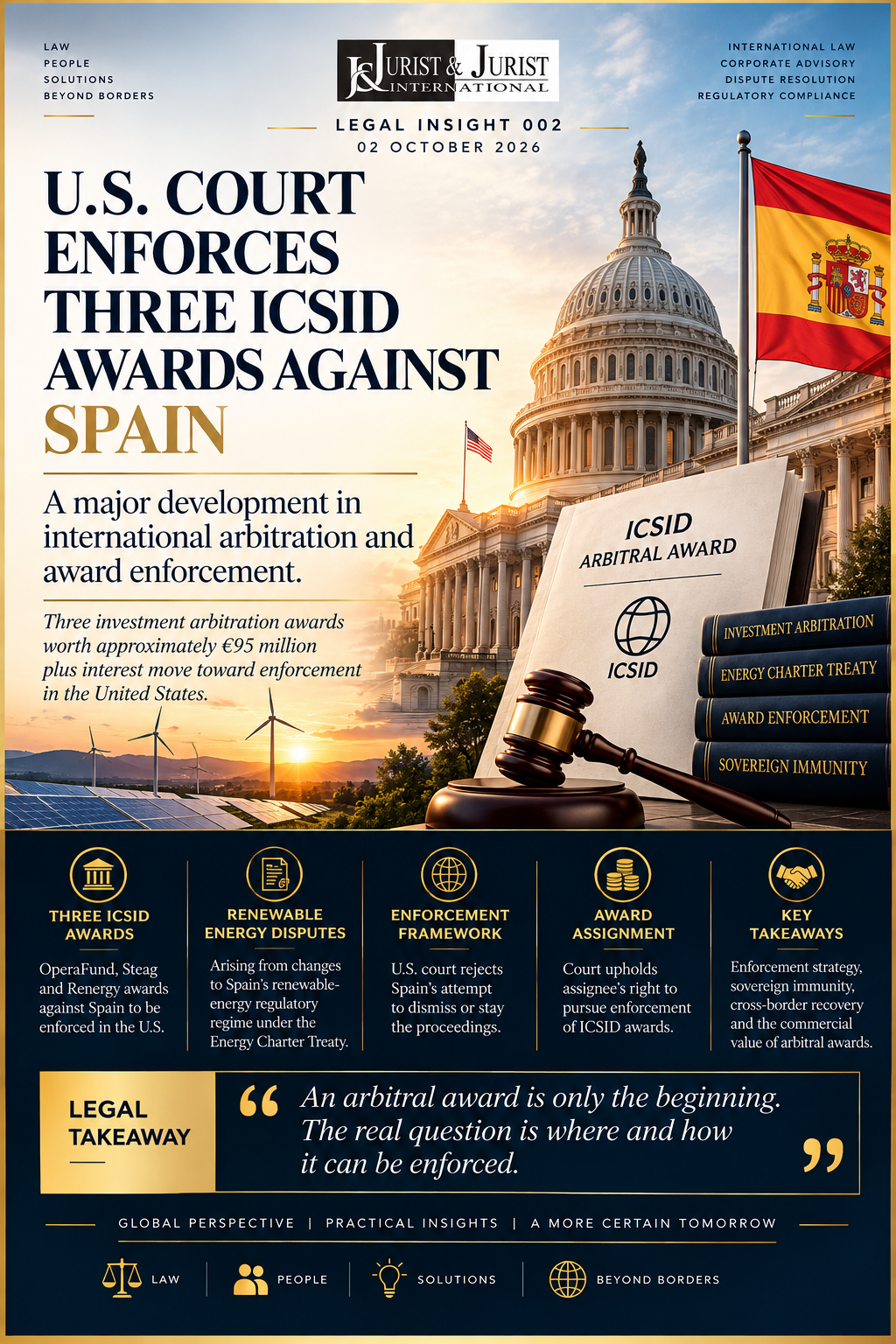
Three investment arbitration awards worth approximately €95 million plus interest move toward enforcement in the United States, reinforcing the strength of the ICSID enforcement framework and highlighting the growing importance of cross-border award enforcement strategy.
International arbitration does not necessarily end when the tribunal delivers its award.
For businesses and investors involved in cross-border disputes, the real commercial question is often what happens next: Can the award actually be enforced—and can the successful party ultimately recover?
A significant decision from the U.S. District Court for the District of Columbia has once again brought this issue into focus.
On 30 September 2026, U.S. District Judge Randolph D. Moss, in Blasket Renewable Investments LLC v. Kingdom of Spain, Civil Action No. 25-1756 (RDM), denied Spain’s motion to dismiss or stay proceedings and ordered judgment in favour of Blasket in the amounts specified in three ICSID arbitral awards.
According to Global Arbitration Review, the three awards are collectively worth approximately €95 million plus interest.
The development is important not merely because Spain faces enforcement of another group of renewable-energy investment awards. It brings together some of the most important issues presently shaping international arbitration and enforcement of arbitral awards: the distinctive enforcement regime applicable to ICSID awards, sovereign immunity, intra-EU investment arbitration, assignment of award rights, and the difference between winning an arbitration and achieving actual recovery.
Three ICSID Awards, One Enforcement Proceeding
The U.S. proceedings concern awards arising from three separate investment arbitrations:
OperaFund Eco-Invest SICAV PLC & Schwab Holding AG v. Kingdom of Spain — ICSID Case No. ARB/15/36.
Steag GmbH v. Kingdom of Spain — ICSID Case No. ARB/15/4.
Renergy S.à r.l. v. Kingdom of Spain — ICSID Case No. ARB/14/18.
The disputes emerged from investments in Spain’s renewable-energy sector and subsequent changes to the regulatory framework governing those investments. The investors pursued claims through arbitration under the Energy Charter Treaty (ECT) and the framework of the International Centre for Settlement of Investment Disputes (ICSID).
The rights and interests in the awards were subsequently assigned to Blasket Renewable Investments LLC, which approached the U.S. court for enforcement. Spain sought dismissal or, alternatively, a stay of the proceedings. The court rejected those requests and ordered judgment in Blasket’s favour in the amounts specified in the awards.
Why the ICSID Enforcement Framework Matters
The decision highlights an important distinction between ordinary international commercial arbitration and arbitration conducted under the ICSID Convention.
Under Article 54 of the ICSID Convention, each Contracting State is required to recognise an ICSID award as binding and enforce its pecuniary obligations as if the award were a final judgment of a court in that State. In the United States, 22 U.S.C. § 1650a gives effect to that obligation.
This significantly restricts the role of the domestic court at the enforcement stage. An enforcement proceeding is not intended to become a second arbitration or a general appeal against the tribunal’s decision.
For international investors, that is commercially significant. The effectiveness of arbitration depends not simply upon obtaining a favourable award but upon the ability to move that award toward recognition and enforcement without reopening the entire underlying dispute.
Sovereign Immunity Does Not Automatically Prevent Enforcement Proceedings
Because the respondent was the Kingdom of Spain, the proceedings also engaged principles of sovereign immunity under the U.S. Foreign Sovereign Immunities Act (FSIA).
The court relied upon the D.C. Circuit’s decision in NextEra Energy Global Holdings B.V. v. Kingdom of Spain, under which U.S. federal courts have jurisdiction under the FSIA arbitration exception in proceedings concerning these intra-EU ICSID awards.
The involvement of a sovereign does not, by itself, make an arbitral award incapable of recognition or enforcement. However, recognition of an award and execution against sovereign assets are separate legal questions. Even after obtaining an enforcement judgment, an award creditor may still have to establish that particular assets can legally be attached or executed against under the applicable sovereign-immunity rules.
The Intra-EU Arbitration Debate Continues Across Borders
The proceedings also sit within the continuing legal debate surrounding intra-EU investment arbitration. Spain has repeatedly relied upon developments in European Union law when resisting enforcement of renewable-energy awards.
But when enforcement moves outside the European Union, the legal framework may change considerably. A U.S. court approaches the matter through the ICSID Convention, U.S. federal law, the FSIA and binding U.S. appellate precedent.
This creates an important practical reality for international investors: the legal treatment of an arbitral award in one jurisdiction may not determine how that same award will be approached elsewhere. For cross-border disputes, enforcement therefore needs to be considered internationally rather than through the law of only one country.
An Important Commercial Question: Can an ICSID Award Be Assigned?
Another notable feature of the proceedings is that Blasket was not the original investor that obtained the three awards. It acquired interests in the awards and subsequently pursued their enforcement.
Spain challenged Blasket’s position as assignee. The court rejected the challenge and treated Blasket as the appropriate party to pursue enforcement.
This aspect of the decision has implications extending beyond the immediate dispute. An international arbitral award may represent a substantial economic right.
Where enforcement is likely to involve lengthy proceedings across several jurisdictions, an original award creditor may not necessarily wish to bear the entire cost, delay and enforcement risk itself. Depending upon the applicable legal framework and the terms governing the award, this creates possibilities involving assignment of award rights, third-party funding, award monetisation and investment in legal claims or awards.
International arbitration is therefore increasingly intersecting with the wider financial market surrounding legal assets and dispute finance.
Winning the Arbitration Is Not the Same as Recovering the Award
Perhaps the most important commercial lesson from the decision is also the simplest: An arbitral victory and actual recovery are two different stages.
An award creditor may still need to determine where the debtor’s assets are located; which jurisdictions provide realistic enforcement opportunities; whether particular assets are protected by sovereign immunity; whether those assets are being used for sovereign or commercial purposes; and whether enforcement should be pursued simultaneously or sequentially across different jurisdictions.
For substantial international disputes, these questions should not arise for the first time after the final award. They should form part of the dispute strategy much earlier.
LEGAL TAKEAWAY
Arbitration strategy should be built around recovery—not merely around obtaining an award.
For investors and businesses entering cross-border transactions, the enforceability of an eventual award should influence the dispute-resolution strategy from the beginning. That means considering the likely location of assets, suitable enforcement jurisdictions, sovereign-immunity exposure, the structure of the counterparty and the practical route from an arbitral award to actual recovery.
The decision also demonstrates the particular significance of the ICSID enforcement framework, under which domestic enforcement proceedings are not intended to provide an unrestricted opportunity to relitigate the underlying investment dispute.
At the same time, Blasket’s position as assignee demonstrates another evolving commercial dimension of international arbitration: an arbitral award may itself carry independent economic value. Depending upon the applicable law and circumstances, award rights may potentially be assigned, financed or monetised, giving an award creditor alternatives to personally pursuing a prolonged multi-jurisdictional enforcement campaign.
For businesses operating internationally, the strategic question should therefore no longer end with: “Can we win the arbitration?” It should extend to: “Where can the award be enforced, what assets may ultimately be reached, and how can the award be converted into actual recovery?”
That is increasingly where international arbitration, cross-border enforcement and commercial strategy converge.
Sources & References
Primary Source: Blasket Renewable Investments LLC v. Kingdom of Spain, Civil Action No. 25-1756 (RDM), U.S. District Court for the District of Columbia, Memorandum Opinion dated 30 September 2026, Judge Randolph D. Moss.
Industry Source: Global Arbitration Review (GAR), “Another three awards enforced against Spain,” reporting on the U.S. enforcement proceedings concerning the three ICSID awards.
Relevant Legal Framework: Convention on the Settlement of Investment Disputes between States and Nationals of Other States (ICSID Convention), particularly Article 54 concerning recognition and enforcement of ICSID awards.
U.S. Statutory Framework: 22 U.S.C. § 1650a — enforcement of ICSID Convention awards in the United States.
Related U.S. Authority: NextEra Energy Global Holdings B.V. v. Kingdom of Spain, 112 F.4th 1088 (D.C. Cir. 2024).
About Jurist & Jurist International Law Firm
Jurist & Jurist International Law Firm advises businesses, investors and corporate groups on international arbitration, commercial arbitration, cross-border disputes, enforcement of arbitral awards and international business law.
The firm assists clients in developing dispute-resolution strategies extending from the management of complex international disputes to cross-border award enforcement and recovery.
Jurist & Jurist International Law Firm
International Arbitration | Cross-Border Disputes | Commercial Dispute Resolution | Enforcement of Arbitral Awards
Copyright © 2012-2025. Jurist & Jurist International is a registered trademark. Unauthorized use, reproduction, or imitation of our name, logo, or design is strictly prohibited and punishable under applicable laws.
Designed by RICKYTECH & CO.