
WhatsApp us on +91 9091913999 or Call us on +91 9811881981
LEGAL INSIGHT 008 | 08 OCTOBER 2026 MOLDOVA PREVAILS IN ENERGY CHARTER TREATY ARBITRATION: THE LINE BETWEEN INVESTOR PROTECTION AND STATE REGULATION
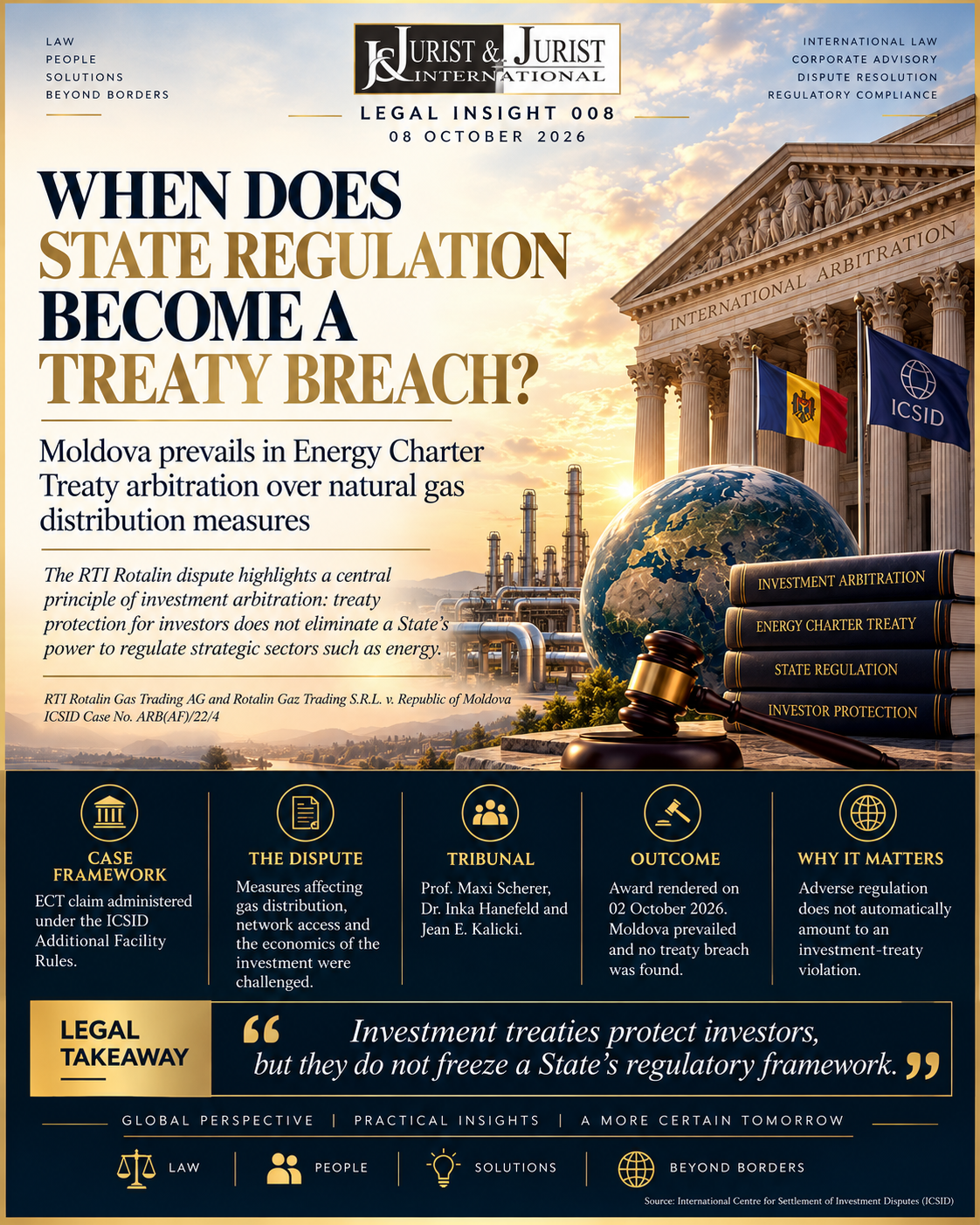
RTI Rotalin Gas Trading AG and Rotalin Gaz Trading S.R.L. v. Republic of Moldova
ICSID Case No. ARB(AF)/22/4
The Republic of Moldova has prevailed in an international investment arbitration brought by RTI Rotalin Gas Trading AG, a Liechtenstein investor, and its Moldovan subsidiary, Rotalin Gaz Trading S.R.L., in a dispute arising from Moldova’s regulation of its natural gas market.
The proceedings were administered by the International Centre for Settlement of Investment Disputes (ICSID) under the ICSID Additional Facility Arbitration Rules, with the investors invoking protections under the Energy Charter Treaty (ECT).
The tribunal rendered its award on 2 October 2026, bringing proceedings registered with ICSID in August 2022 to a conclusion.
THE INVESTMENT AND THE DISPUTE
RTI Rotalin Gas Trading AG held the investment through Rotalin Gaz Trading S.R.L., a Moldovan company operating in the natural gas sector.
The dispute concerned regulatory measures affecting the operation and economics of the gas distribution business, including issues surrounding access to Moldova’s natural gas network and the treatment of investments while tariffs for gas distribution services were being determined.
The investors alleged that measures adopted by Moldovan authorities adversely affected their investment and were inconsistent with Moldova’s obligations under the Energy Charter Treaty.
The ECT has historically provided foreign investors in the energy sector with treaty-based protections and access, subject to the requirements of the treaty, to investor-State arbitration where qualifying governmental measures are alleged to have breached those protections.
THE ARBITRATION
ICSID registered the arbitration on 3 August 2022.
The tribunal was constituted on 2 December 2022 and comprised Prof. Maxi Scherer as President, Dr. Inka Hanefeld as the arbitrator appointed by the Claimants, and Jean E. Kalicki as the arbitrator appointed by the Respondent.
The proceedings subsequently involved extensive written submissions, document production and procedural applications.
A hearing on jurisdiction and the merits was held in Geneva beginning on 2 December 2024, followed by post-hearing submissions in 2025 and submissions concerning costs in January 2026.
On 2 October 2026, the tribunal rendered its final award.
WHY THIS DISPUTE MATTERS
The dispute highlights one of the most significant tensions in modern investment arbitration:
When does legitimate State regulation become a breach of an international investment treaty?
Foreign investors operating in highly regulated sectors naturally expect a degree of legal stability, regulatory transparency and protection against arbitrary State conduct.
At the same time, international investment treaties do not ordinarily guarantee that the regulatory environment governing an investment will remain permanently unchanged.
Governments continue to possess regulatory authority over sectors involving public infrastructure, energy security, consumer protection, pricing, market organisation and essential services.
The legal issue therefore is not simply whether a governmental measure adversely affects an investor. The more fundamental question is whether the particular conduct of the State crosses the threshold established under the applicable treaty.
REGULATORY LOSS IS NOT AUTOMATICALLY A TREATY VIOLATION
This distinction is particularly important for investors operating in sectors such as energy, infrastructure, utilities, telecommunications, mining, transport and public services.
Businesses in these sectors frequently depend upon licences, tariff structures, regulatory approvals, concessions, network access and continuing interaction with public authorities.
A change in regulation may therefore substantially affect the profitability—or even the commercial viability—of an investment.
However, commercial loss and treaty breach are not necessarily the same thing.
For an investor-State claim to succeed, the investor generally needs to establish that the State’s conduct falls within and violates a specific protection available under the applicable investment treaty.
This makes the legal architecture surrounding an investment almost as important as its underlying commercial economics.
A LESSON IN INVESTMENT STRUCTURING
The Moldova dispute also demonstrates why treaty protection should ideally be considered before an international investment is made, rather than only after a dispute has arisen.
Cross-border investors should examine the jurisdiction through which the investment is structured, the applicable bilateral or multilateral investment treaties, the nationality requirements for treaty protection, the dispute-resolution mechanism available under the treaty, the regulatory framework governing the investment, and the interaction between contractual remedies and treaty-based remedies.
Investment structuring is therefore not merely a tax or corporate exercise. For substantial cross-border projects, it is also an important element of dispute-risk management.
THE ENERGY SECTOR REMAINS PARTICULARLY SENSITIVE
Energy disputes present an especially difficult balance.
States must maintain reliable energy supplies, protect consumers, regulate pricing and respond to changing economic or geopolitical conditions.
Investors, however, may commit substantial capital on the basis of licences, tariff methodologies, government policies or regulatory expectations existing at the time of investment.
When those circumstances change, disputes can quickly move beyond domestic administrative or contractual remedies and enter the sphere of public international law and investor-State arbitration.
The Rotalin proceedings provide another illustration of that intersection.
LEGAL TAKEAWAY
Investment treaties protect foreign investors, but they do not necessarily freeze a State’s regulatory framework.
An investor adversely affected by governmental regulation must still establish that the complained-of conduct constitutes a breach of a specific international obligation owed by the State.
For governments, the dispute underscores the importance of transparent, non-arbitrary and legally structured regulatory action.
For international investors, the lesson is equally significant: regulatory due diligence, treaty planning and dispute-resolution strategy should form part of the investment architecture from the outset—not merely after a dispute has emerged.
The increasing interaction between international investment law, energy regulation and State policy makes early legal structuring particularly important for businesses entering regulated foreign markets.
Source: International Centre for Settlement of Investment Disputes (ICSID) — RTI Rotalin Gas Trading AG and Rotalin Gaz Trading S.R.L. v. Republic of Moldova, ICSID Case No. ARB(AF)/22/4.
Note: The final award was rendered on 2 October 2026. As of 8 October 2026, the text of the award is not publicly available on the ICSID case database; accordingly, this Insight does not attribute unpublished reasoning to the Tribunal.
Copyright © 2012-2025. Jurist & Jurist International is a registered trademark. Unauthorized use, reproduction, or imitation of our name, logo, or design is strictly prohibited and punishable under applicable laws.
Designed by RICKYTECH & CO.