
Public Interest Litigation (PIL) Lawyers in Delhi High Court: Process, Eligibility and Legal Guidance
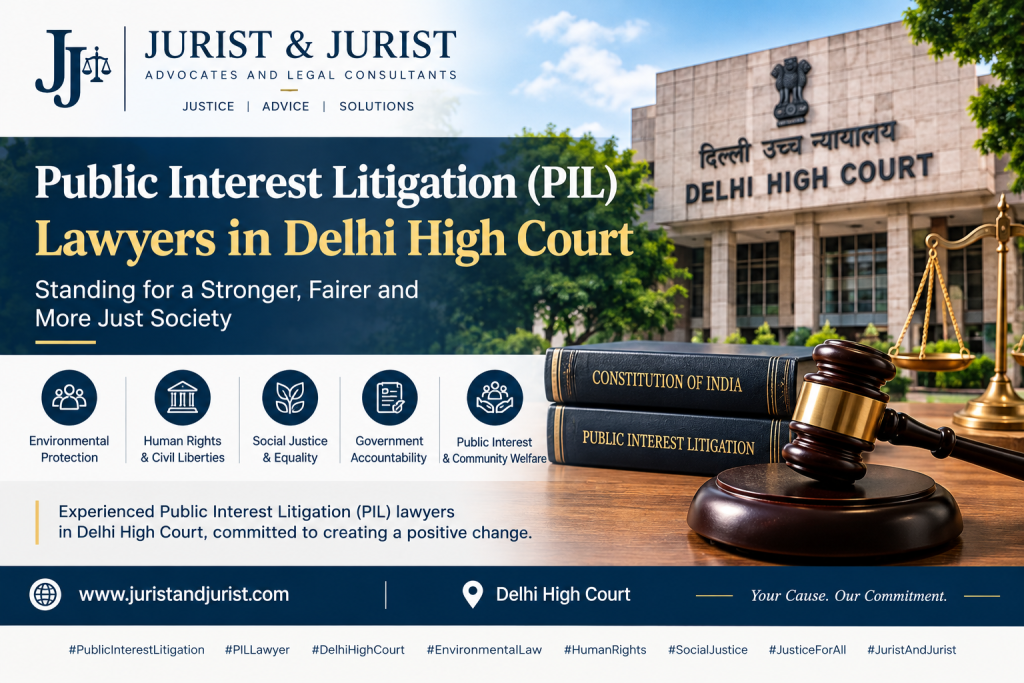
Public Interest Litigation plays an important role in addressing issues that affect the wider community, particularly when public rights, government responsibilities or the interests of vulnerable groups require judicial attention. From environmental concerns and public health to access to essential services and the protection of constitutional rights, a properly presented PIL can provide a legal route for raising matters of genuine public importance.
Finding experienced Public Interest Litigation (PIL) Lawyers in Delhi High Court can help individuals, social organisations and other eligible petitioners understand whether their concerns may justify judicial intervention. A lawyer can assess the facts, identify the appropriate legal grounds, prepare supporting documents and explain the procedural requirements for filing a petition.
The Delhi High Court exercises constitutional jurisdiction under Article 226 of the Constitution of India and has specific rules governing Public Interest Litigation. These rules require petitioners to explain the public interest involved, disclose the source of their information and provide relevant details about the people or institutions likely to be affected.
For people seeking legal information and assistance, https://www.juristandjurist.com/ is a website to explore. Before proceeding with a PIL, it is important to understand the purpose of the petition, the evidence available and the legal procedure that applies to the particular issue.
Key Takeaways
- Public Interest Litigation is intended to address genuine public concerns rather than merely private disputes.
- Article 226 provides the Delhi High Court with constitutional writ jurisdiction, subject to applicable legal requirements.
- The Delhi High Court has specific PIL Rules governing the contents and filing of petitions.
- Petitioners should verify allegations, preserve supporting evidence and disclose relevant facts accurately.
- A PIL may be considered in areas such as environmental protection, public health, public accountability and access to essential services, depending on the circumstances.
- Filing a PIL does not guarantee admission or a favourable order. The court determines whether the matter warrants judicial intervention.
What Is Public Interest Litigation?
Public Interest Litigation, commonly known as PIL, is a legal mechanism through which a matter affecting the public interest can be brought before a court. It may be relevant when an alleged failure to perform a public duty, an unlawful government action or a wider violation of rights affects a community or a group of people.
Unlike ordinary litigation that primarily concerns a dispute between specific parties, a PIL focuses on a broader public concern. The court examines the nature of the issue, the legal grounds, the evidence and whether the requested relief is appropriate.
For example, a petition may raise concerns about environmental pollution affecting residents, the implementation of public welfare obligations or a public authority’s alleged failure to fulfil a legal duty. Whether a particular issue is suitable for PIL proceedings depends on the facts and applicable law.
PIL is not intended to be a shortcut for settling personal rivalries, pursuing private commercial interests or obtaining publicity. Courts can scrutinise the petitioner’s intentions and the reliability of the allegations before deciding whether to entertain a matter.
Role of Public Interest Litigation (PIL) Lawyers in Delhi High Court
Preparing a PIL involves more than identifying a problem and submitting a complaint. The petitioner must establish a credible factual basis, identify the relevant legal provisions and explain why the court’s intervention is appropriate.
Public Interest Litigation (PIL) Lawyers in Delhi High Court may assist with several stages of this process.
1. Assessing Whether the Issue Qualifies as a PIL
The first step is to determine whether the issue genuinely concerns the public interest and whether the Delhi High Court is an appropriate forum.
A lawyer can review the nature of the alleged violation, the public authority involved, the affected population and the relief being considered. They can also assess whether another statutory remedy, administrative process or judicial forum may be more appropriate.
2. Researching Applicable Laws and Constitutional Provisions
A PIL must have a clear legal foundation. Depending on the matter, this may involve constitutional provisions, environmental legislation, public health regulations, administrative law or statutes governing a public authority.
Legal research helps connect the facts to the relevant legal obligations. It also helps distinguish a legally actionable issue from a general grievance or policy disagreement that may not justify the relief requested.
3. Preparing the Petition and Supporting Documents
A lawyer can help organise the petition, identify necessary parties, prepare supporting affidavits and ensure that the required disclosures are included.
The drafting should explain the issue clearly, establish the factual background and specify the directions or relief sought from the court. Unsupported allegations and vague requests can weaken the presentation of a case.
4. Advising on Filing and Procedural Requirements
The Delhi High Court has specific rules for PIL proceedings. Legal assistance may include preparing the prescribed petition structure, organising annexures, reviewing affidavits and addressing procedural objections raised by the Registry.
5. Representing the Petitioner During Proceedings
If the matter is listed, a lawyer may present the legal grounds, respond to questions from the court, address objections and explain the requested relief. Further proceedings may involve responses from government departments, additional affidavits or clarification of factual issues.
The actual process depends on the case and the court’s directions.
Common Issues That May Give Rise to a PIL
A PIL may concern a range of public issues. However, the seriousness of a complaint alone does not establish that it qualifies for PIL proceedings. There must be an appropriate legal basis and a reason for judicial intervention.
Environmental Protection and Pollution
Environmental concerns may affect large communities, particularly where pollution, waste disposal or alleged non-compliance with environmental obligations creates risks to public health.
A potential petition may examine whether the responsible authority has failed to perform a statutory duty or whether an action violates applicable environmental law.
Useful supporting material may include official inspection reports, government correspondence, credible photographs, publicly available data and records of complaints made to the relevant authorities.
Public Health and Sanitation
Public health concerns can involve sanitation, waste management, access to essential public facilities or the implementation of legally required health protections.
The petition should identify the public problem, the authority responsible and the legal obligation allegedly breached. It should also distinguish verified facts from assumptions or unconfirmed reports.
Government Accountability and Administrative Inaction
A PIL may be considered where an alleged unlawful administrative action or failure to perform a public duty has wider consequences.
The legal analysis must identify the relevant duty or legal requirement. A disagreement with a government policy, by itself, does not automatically establish grounds for a successful PIL.
Rights of Vulnerable Communities
Public Interest Litigation may be relevant where the rights or welfare of disadvantaged groups are affected by alleged unlawful action or inaction.
The petitioner should explain who is affected, the nature of the problem and why judicial intervention may be necessary. Evidence and the precise relief requested are important to this assessment.
Public Infrastructure and Essential Services
Issues concerning public safety, essential facilities or the implementation of statutory obligations may sometimes raise public interest questions.
The suitability of a PIL depends on the applicable legal framework, the authority involved, the evidence and the availability of other remedies.
Legal Framework for Filing a PIL in the Delhi High Court
Understanding the relevant legal framework helps petitioners approach the process with realistic expectations.
Article 226 of the Constitution of India
Article 226 empowers High Courts to issue certain writs, directions and orders for the enforcement of fundamental rights and for other legally recognised purposes.
The Delhi High Court’s PIL Rules specifically address the exercise of jurisdiction under Articles 226 and 227 in relation to Public Interest Litigation. The nature of the relief and the legal basis of a particular petition determine which provisions and procedures are relevant.
Article 226 does not mean that every public complaint must be entertained as a PIL. The court retains the authority to examine maintainability, jurisdiction, facts and the appropriateness of the requested relief.
Delhi High Court (Public Interest Litigation) Rules, 2010
The Delhi High Court has published the Delhi High Court (Public Interest Litigation) Rules, 2010. These rules explain the requirements for petitions intended to be treated as PILs.
According to the official rules, a PIL petition must include specific statements about the petitioner’s lack of personal interest, the source of information, the class of persons who may benefit and the persons or bodies likely to be affected by the requested orders.
Read the official document here: Delhi High Court PIL Rules, 2010. The court also addresses PIL filing requirements in its official FAQs.
Fundamental Rights and Public Duties
Some PILs involve alleged violations of fundamental rights, while others concern statutory obligations or unlawful administrative action. The legal basis must be identified carefully.
A lawyer should examine whether the facts support the relevant constitutional or statutory claim and whether the relief requested falls within the court’s jurisdiction.
Important Requirements Before Filing a PIL
The Delhi High Court’s PIL Rules set out specific disclosure requirements. Petitioners should review the current official rules and obtain legal guidance before filing.
Disclose the Absence of Personal Interest
The rules require the petition to state that the petitioner has no personal interest in the litigation and that the petition is not motivated by self-gain or gain for another person, institution or body.
The stated purpose should genuinely reflect the petitioner’s reasons for bringing the matter to court.
Explain the Source of Information
The petition should disclose how the petitioner learned about the facts and what inquiries or investigations were undertaken to check their accuracy.
This makes factual verification an important part of PIL preparation. Petitioners should retain the records supporting their statements and avoid presenting rumours or unverified allegations as established facts.
Identify the Affected Class of People
The petition should identify the group or class of people for whose benefit it is filed and explain why they may be unable to approach the courts themselves.
This helps demonstrate the public dimension of the issue rather than merely asserting that the matter is important.
Identify the Relevant Parties
The rules require disclosure of the persons, bodies or institutions likely to be affected by the orders sought and relevant information about the proposed respondents.
Identifying the appropriate parties is important because the court may need to hear from the authorities or other entities responsible for the issue.
Request Specific and Legally Appropriate Relief
A petition should explain what action the court is being asked to take and why that action is legally justified.
For example, the requested relief might concern consideration of a representation, performance of a statutory duty or compliance with a legal requirement. The precise remedy depends on the circumstances and the court’s powers.
Step-by-Step Process for Filing a PIL in Delhi High Court
Although individual matters differ, the following general stages can help a prospective petitioner understand the process.
Step 1: Define the public issue. Explain the problem, the affected community and why it extends beyond a private dispute.
Step 2: Collect reliable evidence. Gather relevant official records, correspondence, photographs, reports and other material that supports the allegations.
Step 3: Consider representations to the appropriate authority. Depending on the circumstances, it may be useful or legally necessary to approach the responsible department before seeking judicial intervention. Preserve any replies or proof of submission.
Step 4: Obtain legal advice. A lawyer can assess jurisdiction, maintainability, alternative remedies, necessary parties and the applicable procedural requirements.
Step 5: Prepare the petition and affidavits. The documents should present the facts accurately, disclose the petitioner’s interest and explain the legal grounds and relief sought.
Step 6: File in accordance with the applicable rules. Follow the Delhi High Court’s filing requirements and any applicable electronic filing directions. The Registry may raise objections if the documents are incomplete or do not meet procedural requirements.
Step 7: Respond to court directions. If the matter is listed, the court may seek responses, request additional material or issue other directions. The petitioner’s legal team should comply with the applicable orders and deadlines.
These steps are a general overview, not a guarantee that a petition will be admitted or decided in a particular way.
Documents and Evidence That May Be Required
The documents required depend on the subject matter and the relief sought. A petitioner should consider preparing:
- A clear chronology of events.
- Copies of relevant complaints or representations submitted to authorities.
- Replies received from government departments or public bodies.
- Official orders, reports, notices or other relevant records.
- Photographs, videos or other supporting evidence, with relevant context.
- Material that helps verify the facts and identify the affected community.
- Details of the authorities or persons whose actions are challenged.
- A list of the relief sought and the legal basis for requesting it.
- The required petition, affidavit and supporting documents in the form prescribed by the applicable rules.
Evidence should be authentic, relevant and presented accurately. Sensitive personal information should be handled carefully, especially where vulnerable individuals or children may be involved.
Common Mistakes to Avoid When Filing a PIL
Filing a Personal Dispute as a Public Interest Matter
A dispute that primarily concerns an individual’s private interests may not be suitable for PIL treatment. Petitioners should identify the broader public concern and explain its legal significance.
Making Unverified Allegations
Serious claims should be supported by credible material. Unsupported accusations can undermine the petition and may create legal risks.
Ignoring Alternative Remedies
Some issues may be addressed through a statutory appeal, administrative complaint or another established legal process. The availability and suitability of such remedies should be assessed before filing.
Failing to Identify the Correct Authority
If the petition seeks action from a particular department or public body, it is important to identify the authority legally responsible for the issue.
Requesting Vague or Impractical Orders
The relief sought should be specific enough for the court to understand the action requested and its legal basis.
Overlooking Filing Rules
Incomplete affidavits, missing documents or failure to comply with procedural requirements can lead to objections and delay. Reviewing the official rules before filing can help reduce avoidable errors.
How to Choose Public Interest Litigation (PIL) Lawyers in Delhi High Court
Selecting legal representation requires careful consideration of the matter’s complexity and the lawyer’s relevant experience.
Assess Constitutional and Writ Litigation Experience
Look for a lawyer familiar with Article 226 proceedings, PIL requirements, writ petitions and the procedural practices of the Delhi High Court.
Evaluate Research and Drafting Skills
PILs often involve extensive factual and legal research. Clear drafting helps the court understand the public concern, relevant legal duties and requested relief.
Discuss Evidence and Maintainability
A lawyer should be willing to examine the strengths and weaknesses of the proposed case, including evidentiary gaps, jurisdictional concerns and alternative remedies.
Clarify Fees and Scope of Work
Before engagement, discuss professional fees, filing-related expenses, the scope of representation and how updates will be communicated.
Expect Honest and Practical Advice
No lawyer can guarantee that a PIL will be admitted or that the court will grant the requested relief. A responsible legal assessment should explain the uncertainties and possible outcomes.
To explore available legal information and services, visit https://www.juristandjurist.com/. Confirm directly whether the services offered match your specific PIL or constitutional litigation requirements.
Frequently Asked Questions
1. Who can file a Public Interest Litigation in Delhi High Court?
The suitability of a petitioner depends on the nature of the issue, the applicable law and the court’s PIL requirements. The petitioner must present a genuine public interest concern and comply with the applicable rules.
2. What is the purpose of a PIL?
A PIL provides a route for raising certain matters of public importance before a court, including issues involving public duties, rights or the interests of affected communities. It is not intended to be used simply to pursue private disputes.
3. Does every public complaint qualify as a PIL?
No. The court may examine the legal basis, jurisdiction, credibility of the facts, petitioner’s motives and the appropriateness of the requested relief before deciding whether to entertain the matter.
4. What are the Delhi High Court PIL Rules?
The Delhi High Court (Public Interest Litigation) Rules, 2010 set out procedural and disclosure requirements for PIL petitions. The official rules should be reviewed before filing.
5. Can a PIL be filed against a government department?
A petition may be considered where the facts and law support judicial review of the relevant public authority’s action or inaction. The correct respondent, jurisdiction and legal remedy must be assessed for the particular matter.
6. How long does a PIL take to resolve?
There is no single timeline for all PILs. The duration depends on factors such as the complexity of the issues, the court’s schedule, responses from the parties, procedural objections and the directions issued during the case.
7. Can a PIL be dismissed?
Yes. A court may decline to entertain or may dismiss a PIL for reasons including lack of maintainability, insufficient legal grounds, unreliable allegations, lack of jurisdiction or concerns about the petitioner’s bona fides. The outcome depends on the case.
Conclusion
Public Interest Litigation can provide an important legal mechanism for bringing genuine public concerns before the judiciary. However, a successful approach requires more than identifying a problem: it requires reliable evidence, a clear legal foundation, compliance with the Delhi High Court’s PIL Rules and a carefully framed request for relief.
When considering Public Interest Litigation (PIL) Lawyers in Delhi High Court, focus on relevant constitutional litigation experience, the quality of legal research, procedural knowledge and the ability to explain the risks and available options.
For further information about legal services, visit https://www.juristandjurist.com/ and confirm whether the available services are appropriate for your matter.
Disclaimer: This article is for general informational purposes only and does not constitute legal advice. The suitability and outcome of a PIL depend on the facts, applicable law, procedural compliance and the court’s assessment. Obtain advice from a qualified lawyer before taking action.