
WhatsApp us on +91 9091913999 or Call us on +91 9811881981
LEGAL INSIGHT 014 | 14 OCTOBER 2026 Can a Foreign Investor Claim US$460 Million When the Investment Treaty Excludes Financial Services?
ICSID Upholds Challenge Against Philippe Sands in Webuild v. Argentina — Renewing the Debate on Arbitral Independence, Impartiality and Conflicts of Interest
International Investment Arbitration | Arbitrator Disqualification | Investor–State Dispute Settlement
A Significant Development in International Investment Arbitration
The independence and impartiality of arbitrators remain fundamental to the legitimacy of international investment arbitration. In a notable development, the unchallenged members of an International Centre for Settlement of Investment Disputes (ICSID) tribunal have upheld a proposal seeking the disqualification of internationally recognised arbitrator Professor Philippe Sands, KC, in Webuild S.p.A. v. Argentine Republic (ICSID Case No. ARB/26/7).
On 9 October 2026, the two unchallenged co-arbitrators upheld the disqualification proposal, resulting in a vacancy on the tribunal and continued suspension of the proceedings. The development has attracted particular attention because the reported challenge concerned Professor Sands’ previous representation of Argentina in investment disputes involving similar material facts and legal issues.
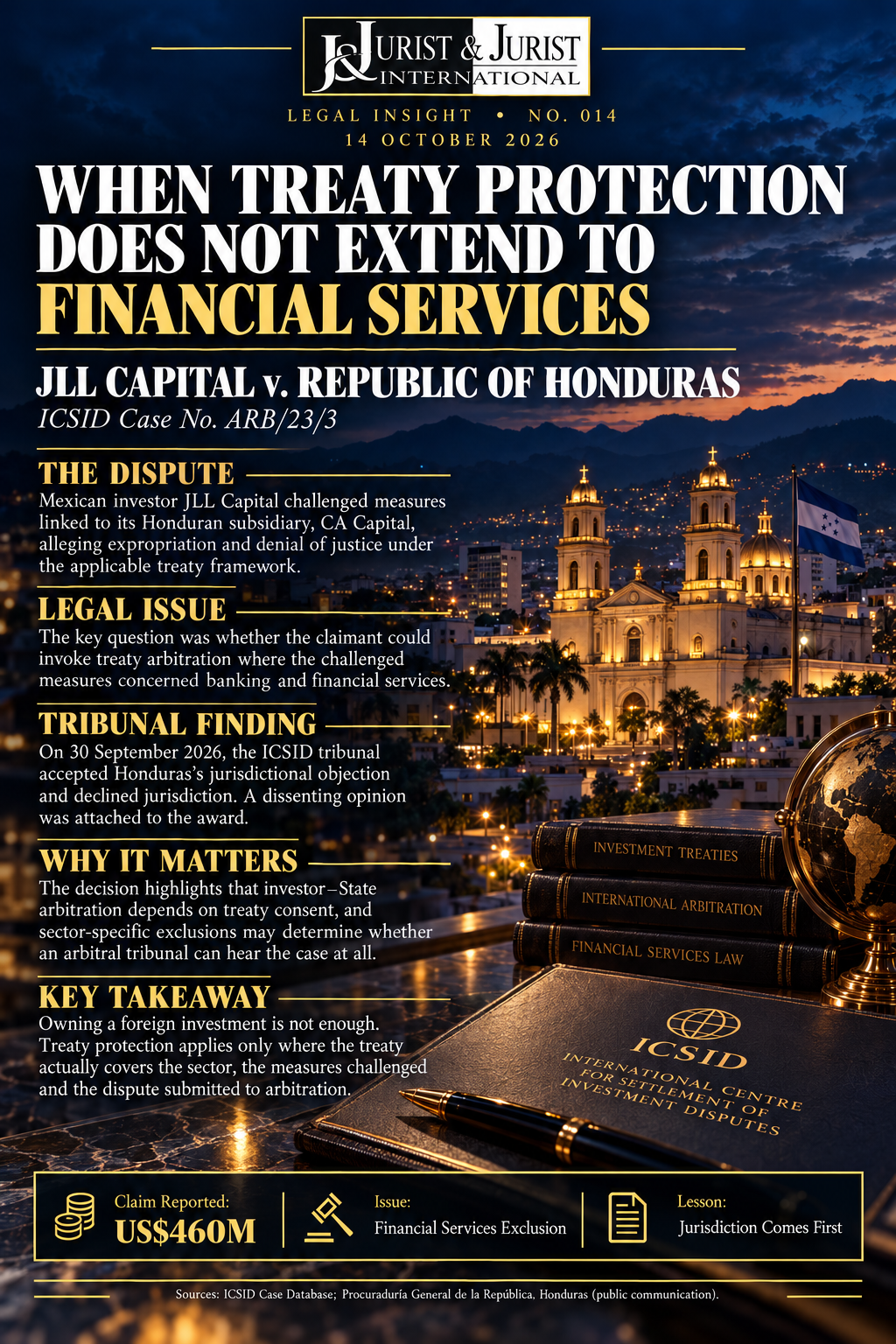
The Dispute: A US$460 Million Investment Claim Against Honduras
International investment treaties provide important protections to foreign investors against certain forms of unlawful State interference. However, the availability of these protections depends upon the scope of the relevant treaty and the jurisdiction conferred upon the arbitral tribunal.
This distinction became decisive in JLL Capital, S.A.P.I. de C.V. v. Republic of Honduras, where a Mexican investor pursued an investment arbitration claim reportedly valued at approximately US$460 million.
The dispute concerned JLL Capital’s investment in its Honduran subsidiary, CA Capital, and arose from judicial proceedings affecting that investment. The claimant alleged that actions attributable to Honduras amounted to expropriation and denial of justice in violation of protections available under the applicable international investment framework.
Honduras challenged the tribunal’s jurisdiction, contending that the measures forming the basis of the dispute related to financial services and were excluded from the investment-protection chapter of the treaty.
On 30 September 2026, the ICSID tribunal accepted the jurisdictional objection by majority, bringing the proceedings to a conclusion without deciding the claimant’s allegations of substantive treaty violations.
The Central Legal Question: Does an Investment Treaty Protect Every Foreign Investment?
Can a foreign investor invoke international arbitration merely because it alleges expropriation or denial of justice, when the measures challenged fall outside the treaty’s agreed investment-protection framework?
Under international investment law, the existence of an investment and the existence of consent to arbitration are separate legal requirements. A foreign investor may possess assets, shares or commercial interests in a host State. Nevertheless, those interests do not automatically confer jurisdiction upon an international arbitral tribunal.
The tribunal must determine whether the treaty applies to the relevant investment, whether the measures complained of fall within its scope, and whether the host State has consented to arbitration of the particular dispute. Where a treaty excludes certain financial services measures from its general investment chapter, the jurisdictional consequences of that exclusion become critical.
What Did the ICSID Tribunal Decide?
According to the official account publicly communicated by the Honduran Attorney General’s Office, the tribunal upheld Honduras’s objection that the dispute concerned financial services measures excluded from the investment-protection chapter invoked by the claimant. The majority therefore concluded that it lacked jurisdiction to entertain the claim.
The reported decision also rejected the claimant’s subsidiary attempt to rely upon the earlier Mexico–Northern Triangle Free Trade Agreement.
The tribunal comprised Juan Pablo Cárdenas Mejía as President, Gabriel Bottini and Stephan Schill as co-arbitrators. The ICSID case record identifies a dissenting opinion by Stephan Schill.
The outcome is legally significant because the dispute was resolved at the jurisdictional level. The tribunal’s decision did not constitute a substantive finding that the alleged conduct was lawful or that the investor had failed to establish expropriation or denial of justice. Rather, the decisive issue was whether the applicable treaty provided a jurisdictional basis for adjudicating those allegations.
Why Is This Decision Important for International Investment Arbitration?
The decision highlights an important structural feature of investor–State dispute settlement: treaty-based arbitration is founded upon consent, not merely upon the seriousness of the allegations or the value of the investment.
- Investment ownership does not automatically establish treaty jurisdiction. A foreign investor’s ownership or control of a local enterprise may establish the existence of an investment, but the availability of treaty protection remains dependent upon the applicable treaty’s substantive and jurisdictional provisions.
- Financial services exclusions may determine the scope of investment protection. Financial markets and institutions often operate under specialised regulatory frameworks. Investment treaties may separately address financial services, preserve certain regulatory powers or exclude particular measures from general investment obligations. The effect of such provisions depends upon the specific treaty language.
- Jurisdictional dismissal is different from dismissal on the merits. An award declining jurisdiction does not necessarily resolve whether the host State acted unlawfully. It means that the particular tribunal lacks authority under the applicable jurisdictional instrument to determine the substantive allegations.
Five Important Lessons for Cross-Border Investors and International Businesses
First — Examine treaty coverage before making the investment. The existence of a bilateral or multilateral investment treaty should not be treated as conclusive evidence that every investment or regulatory dispute will be protected.
Second — Identify sector-specific exclusions. Investments involving banking, financial institutions, lending, insurance and other regulated activities require particular attention to the treaty’s financial services provisions and reservations.
Third — Distinguish commercial loss from a treaty violation. Adverse financial consequences or State intervention do not, without more, establish a breach of international investment obligations.
Fourth — Assess jurisdiction before initiating arbitration. Investors should evaluate treaty consent, applicable exclusions, temporal coverage, the identity of the protected investor and the nature of the challenged measures before pursuing costly international proceedings.
Fifth — Incorporate treaty protection into cross-border risk management. Effective investment planning requires coordination between transaction structuring, international treaty analysis, regulatory compliance and dispute resolution strategy.
The Broader International Law Perspective
The award illustrates the continuing interaction between international investment protection and the regulatory authority retained by sovereign States. Investment treaties are intended to provide legally enforceable protections while defining the boundaries of the commitments undertaken by contracting States.
For investors, these boundaries determine the remedies potentially available when governmental action affects their investments. For States, carefully drafted treaty exclusions may preserve agreed areas of regulatory authority and limit exposure to claims falling beyond their consent to arbitration.
However, the Honduras decision should not be interpreted as establishing a general exemption for financial services from investor–State arbitration. Different treaties provide different degrees of protection, and some contain dedicated financial services obligations and dispute settlement provisions. The result in each case must therefore depend upon the language of the applicable instrument and the character of the disputed measures.
LEGAL TAKEAWAY
International investment arbitration depends upon the scope of treaty consent, not merely upon the existence of a foreign investment or allegations of State misconduct. The Honduras decision demonstrates that sector-specific exclusions may prevent an arbitral tribunal from examining even a substantial expropriation claim. For cross-border investors, understanding treaty coverage before investing is as important as securing substantive investment protections.
About Jurist & Jurist International
Jurist & Jurist International Law Firm is an India-based law firm engaged in corporate and commercial law, international arbitration, cross-border dispute resolution, foreign investment advisory and international business law. Through its Knowledge Centre and Legal Insights series, the firm examines significant judicial, arbitral and regulatory developments affecting international commerce, investment protection and dispute resolution.
Sources and References
Primary case record: JLL Capital, S.A.P.I. de C.V. v. Republic of Honduras, ICSID Case No. ARB/23/3, Award dated 30 September 2026. Official ICSID case database: https://icsid.worldbank.org/cases/case-database/case-detail?CaseNo=ARB%2F23%2F3
Official public communication: Procuraduría General de la República, Honduras, announcement dated 12 October 2026 concerning the jurisdictional decision in ICSID Case No. ARB/23/3.
Research note: The ICSID case record confirms the proceedings and award. The reported jurisdictional reasons and claim value are drawn from Honduras’s public account of the outcome. As the complete reasoning of the award and dissent was not available for independent examination at the time of preparation, no unpublished findings or treaty-article interpretations have been attributed directly to the tribunal.
This publication is intended for legal knowledge and professional awareness and does not constitute legal advice.
Copyright © 2012-2025. Jurist & Jurist International is a registered trademark. Unauthorized use, reproduction, or imitation of our name, logo, or design is strictly prohibited and punishable under applicable laws.
Designed by RICKYTECH & CO.