
WhatsApp us on +91 9091913999 or Call us on +91 9811881981
Can Arbitration End a Claim Early? Hong Kong Court Upholds HKIAC Early Determination Award
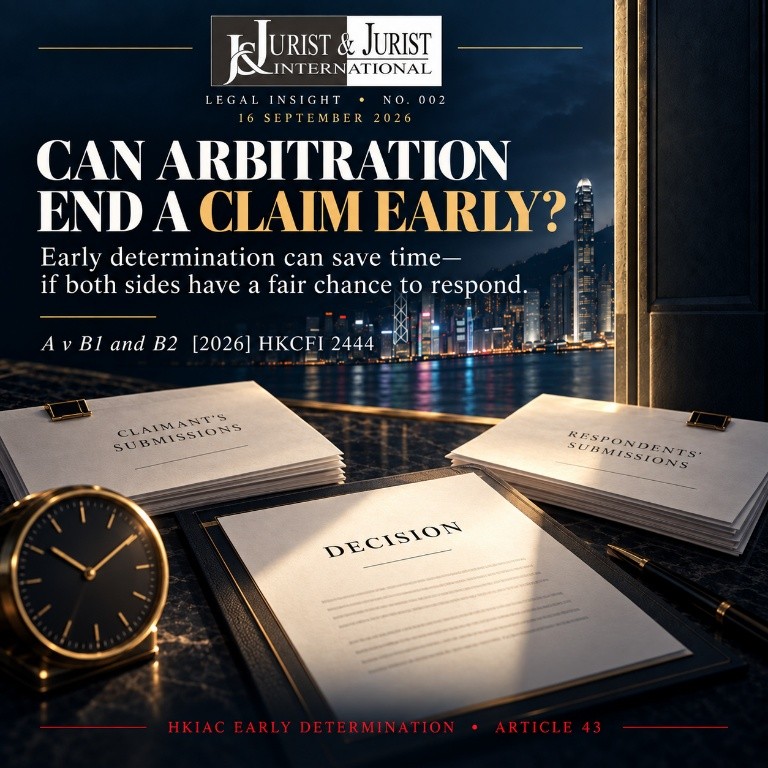
Legal Insight No. 002 | 16 September 2026
Jurist & Jurist International
The Hong Kong Court of First Instance upheld an HKIAC early determination award in A v B1 and B2 [2026] HKCFI 2444.
What does the decision mean for procedural fairness, arbitration costs and challenges to awards?
A full hearing is not necessary in every arbitration. Where a decisive point of law or fact can be resolved early, an arbitral tribunal may be able to dispose of a claim before the parties incur the time and expense of a complete merits hearing. The question is whether that speed comes with a fair opportunity for both sides to present their case.
The Hong Kong Court of First Instance addressed that question in A v B1 and B2 [2026] HKCFI 2444. It refused to set aside an award that dismissed the claimant’s entire case under the Hong Kong International Arbitration Centre (HKIAC) Early Determination Procedure. It also upheld the tribunal’s subsequent Costs Award.
The decision offers useful guidance for businesses and lawyers considering early determination in international commercial arbitration. It shows how a procedure designed to save time can withstand judicial scrutiny when the issues are sufficiently clear and the parties have been heard.
What is early determination in arbitration?
Court litigation may offer summary judgment, allowing suitable claims or defences to be resolved without a full trial. Arbitration rules have developed procedures serving a comparable purpose. Under Article 43 of the 2018 HKIAC Administered Arbitration Rules, applied in this case, a party may ask the tribunal to determine a suitable point of law or fact at an early stage.
Early determination is not a shortcut available for every disputed claim. Its usefulness depends on the issue presented, the applicable rules and the process followed. A tribunal must be able to understand what it is being asked to decide, and the opposing party must have a fair chance to answer.
That balance between efficient arbitration and procedural fairness was central to A v B1 and B2.
The commercial dispute: real estate assets and holdback amounts
The parties’ dispute arose from agreements concerning the sale of corporate vehicles holding real estate assets. The agreements provided for portions of the purchase price to be withheld as holdback amounts. Those amounts would become payable to the claimant if specified contractual conditions were satisfied or waived within the agreed period.
The relevant long-stop date was 18 January 2023. The claimant sought an extension, but the respondents refused. Several conditions remained unsatisfied when the deadline passed, and the respondents retained the holdback amounts.
The claimant commenced HKIAC arbitration. It argued that the respondents had unreasonably refused to extend the deadline and that the agreements did not entitle them to retain the withheld amounts.
The respondents applied under Article 43 for early determination. After receiving written submissions and hearing oral arguments, the tribunal dismissed the claimant’s claims in a Partial Award. It later issued a Costs Award requiring the claimant to pay the respondents’ costs.
Why did the claimant challenge the awards?
The claimant asked the Hong Kong Court of First Instance to set aside both awards.
Its challenge to the Partial Award focused on the way the early determination procedure had been used. The claimant argued that the relevant points of law or fact had not been adequately identified, contrary to Article 43. It said that this deprived it of a fair opportunity to present its case. It also argued that the tribunal had decided matters beyond the early determination application and raised objections concerning the award’s reasoning and Hong Kong public policy.
The challenge to the Costs Award was separate. The claimant had requested a more detailed breakdown of the respondents’ lawyers’ fees. It argued that, without such particulars, it could not respond fairly to the costs claim or assess whether the costs awarded were reasonable.
The Court examined these complaints as potential grounds for setting aside arbitral awards, rather than as an invitation to decide the underlying commercial dispute again.
How did the Court assess procedural fairness?
The Court found that the points for early determination were sufficiently identified in the respondents’ application and supporting documents. Article 43 did not prescribe a particular degree of precision with which every point of law or fact had to be stated. The tribunal had discretion to manage the procedure, provided the parties understood the issues and could address them fairly.
On the facts, the claimant had several opportunities to do so. It responded through written submissions and made oral submissions at a hearing. The Court therefore rejected the argument that the claimant had been denied a fair and reasonable opportunity to present its case.
The claimant also relied on alleged technical defects in the early determination process. The Court regarded those defects as minor. Its assessment took account of the claimant’s full participation in the procedure without raising the relevant objections at the time. A technical complaint made after an unfavourable award did not, in these circumstances, establish serious procedural unfairness.
This does not mean Article 43’s requirements can be ignored. The point is more precise: a court will consider whether the issues were understood, whether each party could respond and whether an alleged defect caused meaningful unfairness.
Did the tribunal decide matters beyond its authority?
The claimant argued that the tribunal had gone beyond the points raised in the respondents’ early determination application.
The Court did not accept that this justified setting aside the Partial Award. For the relevant jurisdictional challenge, the critical inquiry concerned the scope of the submission to arbitration. That inquiry could not simply be reduced to the claimant’s characterisation of the scope of a procedural application. The Court found no basis to conclude that the tribunal had decided matters outside the arbitration submitted to it.
The Court also rejected the claimant’s objections to the award’s reasoning and its public policy challenge. A party’s disagreement with an arbitral tribunal’s interpretation or conclusion does not, without an established ground for intervention, make the award invalid.
Why was the Costs Award upheld?
The claimant’s inability to obtain the fee breakdown it wanted did not make the Costs Award procedurally unfair.
The Court held that the tribunal had discretion to assess arbitration costs using a broad approach informed by its experience. It was not required to apply the detailed fee-assessment practices used by courts or demand an hour-by-hour account in every case.
The claimant had been able to make submissions and criticise the respondents’ costs claim. Its remaining objections went to the merits of the tribunal’s costs assessment. They did not establish a ground to set aside the Costs Award. The Court dismissed the award challenges and permitted enforcement of that award.
What does the decision mean for businesses using arbitration?
A v B1 and B2 confirms that early determination can have a substantial effect: it may dispose of an entire arbitration claim, not merely narrow the issues for a later hearing. The resulting award can survive a court challenge where the procedure has been fair.
For the party making an early determination application, the practical work starts with the issue itself. It should identify the point of law or fact it wants determined, show why that point is suitable for early resolution and state the decision sought from the tribunal.
For the party responding, the focus should be equally precise. It should address the identified point and explain why further evidence or a fuller hearing is needed, if that is its position. If it believes the application or procedure is unfair, it should raise the objection during the arbitration, when the tribunal can consider and potentially address it.
Both parties should remember that a set-aside court has a limited role. It can examine established grounds such as serious procedural unfairness or an award beyond the tribunal’s authority. It does not ordinarily conduct a fresh assessment of the tribunal’s commercial findings or costs decision.
Our takeaway
Identify suitable points of law or fact clearly when seeking early determination, give the other party a fair chance to respond, and raise any procedural objection while the arbitration is underway.
The value of early determination lies in resolving a dispute sooner without sacrificing fairness. A v B1 and B2 shows that, when those requirements are met, an HKIAC award made through the procedure can withstand a challenge before the Hong Kong courts.
Sources: Hong Kong Court of First Instance judgment, A v B1 and B2 [2026] HKCFI 2444; Des Voeux Chambers case analysis; Tanner De Witt review of the award and costs challenges.
Copyright © 2012-2025. Jurist & Jurist International is a registered trademark. Unauthorized use, reproduction, or imitation of our name, logo, or design is strictly prohibited and punishable under applicable laws.
Designed by RICKYTECH & CO.