WhatsApp us on +91 9091913999 or Call us on +91 9811881981
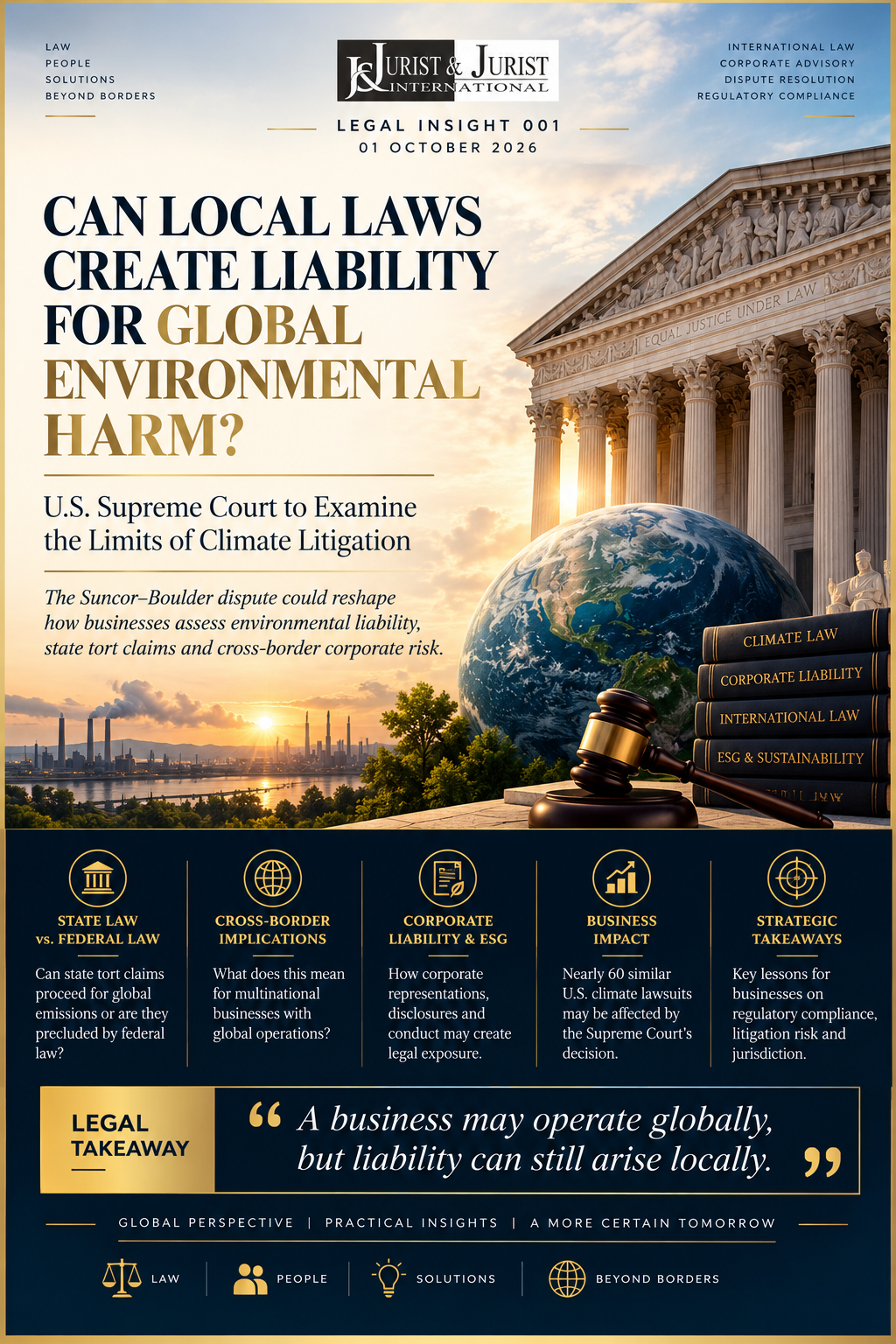
Can Local Laws Create Liability for Global Environmental Harm? U.S. Supreme Court to Examine the Limits of Climate Litigation
Climate change is no longer only a question of environmental regulation.
It is increasingly becoming a question of corporate liability.
On 5 October 2026, the U.S. Supreme Court is scheduled to hear Suncor Energy (U.S.A.) Inc. v. County Commissioners of Boulder County, a closely watched dispute concerning whether companies can face claims under state law for alleged harm connected with greenhouse-gas emissions that are inherently interstate and international.
The importance of the case extends well beyond two energy companies.
Nearly 60 state and local governments in the United States have brought similar climate-related lawsuits, according to submissions referenced by Reuters. The Supreme Court’s treatment of the Boulder dispute could therefore significantly influence whether this developing category of climate litigation continues through state courts.
For businesses operating internationally, the case raises an even broader question:
When a company’s commercial activities extend across jurisdictions, can it be exposed to liability under local law for consequences alleged to arise from a global phenomenon? |
That is what makes Suncor v. Boulder an important development not merely in environmental law, but in corporate law, international business law, regulatory compliance and cross-border litigation.
What Is the Suncor–Boulder Dispute?
The City of Boulder and Boulder County, Colorado, commenced proceedings in 2018 against ExxonMobil and Suncor entities.
The plaintiffs allege that the companies contributed to climate change through the production, promotion and sale of fossil-fuel products and that they misled the public regarding climate-related risks.
They seek monetary relief toward alleged past and future climate-related costs, including expenditure associated with infrastructure, environmental damage, emergency management and public-health impacts.
The companies deny wrongdoing.
The dispute has now reached the U.S. Supreme Court after the Colorado Supreme Court allowed the state-law claims to proceed.
But the question before the U.S. Supreme Court is not simply whether climate change has caused damage or whether particular companies should ultimately pay compensation.
The issue is more fundamental:
Which system of law has authority to determine such liability?
The Legal Question: Federal Law or State Law?
The Supreme Court proceedings concern whether federal law precludes certain state-law claims seeking damages for harms allegedly caused by the effects of greenhouse-gas emissions.
The Court has separately directed the parties to address whether it has statutory and constitutional jurisdiction to decide the dispute at its present stage.
This creates a significant legal contest between two concepts.
The companies’ position
ExxonMobil and Suncor argue, among other things, that climate change arises from worldwide greenhouse-gas emissions and therefore cannot effectively be regulated indirectly through the tort law of individual states.
Their position raises the doctrine of federal pre-emption.
Put simply, pre-emption addresses circumstances in which federal law occupies or governs an area in a manner that prevents conflicting or overlapping state-law intervention.
The companies contend that Boulder’s claims intrude into an area governed by federal law, including the Clean Air Act, and that allowing individual states to impose liability for worldwide emissions could effectively permit one state’s law to reach conduct occurring far beyond that state’s borders.
Boulder’s position
Boulder approaches the dispute differently.
Its case is framed through traditional state-law causes of action and alleged local harm. The argument, in substance, is that the existence of federal environmental regulation does not necessarily eliminate traditional remedies available under state law for allegedly wrongful corporate conduct.
The distinction is crucial.
One side characterises the dispute as an attempt to regulate a global emissions problem through local law.
The other characterises it as an attempt to obtain a local legal remedy for alleged corporate conduct and resulting local harm.
The Supreme Court must now examine where the legal boundary lies.
Why Does Federal Pre-emption Matter to Businesses?
The principle involved extends considerably beyond climate litigation.
Modern businesses rarely operate within a single legal framework.
A multinational corporation may simultaneously be subject to:
- federal or national regulation;
- state or provincial legislation;
- environmental requirements;
- consumer-protection laws;
- disclosure obligations;
- contractual duties;
- tort and civil liability; and
- laws of foreign jurisdictions in which it conducts business.
Compliance with one regulatory regime therefore does not necessarily answer whether liability can arise under another.
That distinction is particularly important for businesses engaged in cross-border operations.
A company may satisfy regulatory requirements governing the manufacture or sale of a product and nevertheless face a separate allegation that its marketing, disclosure, representations or wider conduct created civil liability.
Suncor v. Boulder therefore illustrates a larger corporate-law question:
Does regulatory compliance necessarily protect a company from private or public-law claims arising from the same underlying activity?
Not necessarily.
The source of the obligation, the nature of the alleged wrongdoing, the applicable jurisdiction and the remedy sought may all be different.
From Environmental Compliance to Corporate Liability
Historically, businesses may have viewed environmental risk primarily through a regulatory lens:
What permits are required? What emission standards apply? What environmental regulations must be followed?
Climate litigation is expanding that conversation.
The questions increasingly include:
What did the company know?
What representations were made regarding its products?
What information was communicated to consumers, investors or regulators?
Could conduct occurring across several jurisdictions create liability in another jurisdiction?
Can historical corporate conduct become the foundation of future civil claims?
This transition is important.
Environmental risk can therefore intersect with corporate governance, disclosure obligations, ESG representations, consumer protection, tort liability and litigation strategy.
For boards, general counsel and businesses with international operations, environmental compliance can no longer necessarily be treated as an isolated compliance function.
It can form part of a broader enterprise legal-risk framework.
The Cross-Border Question: Where Does Liability Begin and End?
Perhaps the most interesting aspect of Suncor v. Boulder is territoriality.
Consider the underlying commercial chain.
A company may extract resources in one jurisdiction, process them in another, market products across several countries and ultimately sell those products to millions of independent consumers.
The resulting environmental consequences may then be alleged in jurisdictions far removed from where the original corporate activity occurred.
Traditional legal systems are territorial.
Modern commerce—and environmental consequences—often are not.
The resulting question is therefore increasingly relevant to international business law:
Which jurisdiction’s law should determine liability when the conduct, product, consumer and alleged damage are spread across different territories?
That is why this dispute deserves attention beyond the energy industry.
Similar jurisdictional questions can potentially arise in other fields involving globally distributed commercial activity, including technology, data protection, consumer products, supply chains and multinational corporate operations—although the governing legal tests in those fields will, of course, differ.
Why the Decision Could Matter Beyond Suncor and ExxonMobil
According to Reuters, nearly 60 U.S. state and local governments have filed similar lawsuits against fossil-fuel companies, with substantial damages being sought across the litigation landscape.
The consequences of the Supreme Court’s eventual interpretation could therefore be substantial.
If federal law is held to preclude the relevant state-law claims, one significant pathway presently being used for climate-related litigation could narrow considerably.
If such state-law claims are permitted to continue, companies may have to defend climate-related proceedings under different state legal regimes.
Either approach would have implications for corporate litigation strategy, jurisdictional risk assessment and environmental liability management.
A Separate Development: Justice Alito’s Recusal
Immediately before the scheduled hearing, Justice Samuel Alito informed the parties that he would no longer participate in the case.
The Supreme Court clerk’s communication did not state the reason for the decision.
Reuters reported that Justice Alito owns shares in certain oil and gas companies, though not ExxonMobil or Suncor Energy. He had also not participated when an earlier stage of the Boulder litigation reached the Supreme Court in 2023.
The recusal is procedurally noteworthy, but the greater significance of the proceedings remains the substantive question concerning the relationship between federal authority and state-law climate liability.
What Should Businesses Learn From This Case?
- Global operations can create local litigation exposure
A business activity undertaken internationally may still become the subject of proceedings in a particular domestic jurisdiction where damage is alleged.
- Regulatory compliance and litigation exposure are different questions
Compliance with environmental or sectoral regulations does not automatically determine whether a separate tort, consumer, disclosure or civil claim can arise.
- Corporate representations are becoming part of the risk equation
Statements concerning products, environmental effects, sustainability and ESG commitments can carry legal consequences beyond conventional advertising or corporate communication.
- Jurisdiction should form part of corporate risk planning
Businesses expanding internationally should examine not only what law regulates their operations, but also where claims arising from those operations could potentially be brought.
- Cross-border legal risk increasingly requires integrated advice
Corporate, regulatory, environmental and dispute-resolution risks can overlap. International businesses therefore benefit from analysing these exposures together rather than treating them as independent legal compartments.
LEGAL TAKEAWAY
The larger lesson from Suncor v. Boulder can be expressed simply:
A business may operate globally, but liability can still arise locally. |
The case demonstrates how traditional legal doctrines are being tested against commercial activities and consequences that cross territorial boundaries.
For businesses, the developing landscape reinforces the importance of looking beyond basic regulatory compliance.
A comprehensive legal-risk assessment increasingly requires consideration of:
Corporate Governance + Regulatory Compliance + Corporate Disclosures + Environmental Liability + Jurisdictional Exposure + Cross-Border Dispute Risk
The U.S. Supreme Court’s consideration of Suncor v. Boulder will therefore be worth following not merely as a climate case, but as part of the wider evolution of cross-border corporate liability and international business risk.
About Jurist & Jurist International Law Firm
Jurist & Jurist International Law Firm advises businesses on corporate and commercial law, international business law, cross-border legal advisory, regulatory compliance, international dispute resolution and complex commercial disputes.
As an international and corporate law firm in Delhi, India, the Firm assists businesses in understanding legal and regulatory issues arising from domestic and cross-border commercial operations.
Knowledge Focus: Climate Litigation | Cross-Border Corporate Liability | International Business Law | Corporate Law | Environmental Liability | Regulatory Compliance | ESG Legal Risk | International Dispute Resolution
Source: Reuters, 28 & 30 September 2026; Supreme Court of the United States, Suncor Energy (U.S.A.) Inc., et al. v. County Commissioners of Boulder County, et al., No. 25-170.
Disclaimer: This Legal Insight is intended solely for general information and knowledge sharing. It does not constitute legal advice, solicitation or advertisement. The legal position may vary depending upon jurisdiction, facts and subsequent judicial developments.
Copyright © 2012-2025. Jurist & Jurist International is a registered trademark. Unauthorized use, reproduction, or imitation of our name, logo, or design is strictly prohibited and punishable under applicable laws.
Designed by RICKYTECH & CO.