WhatsApp us on +91 9091913999 or Call us on +91 9811881981
India–Morocco Trade Relations: The Emerging US$8 Billion Economic Corridor
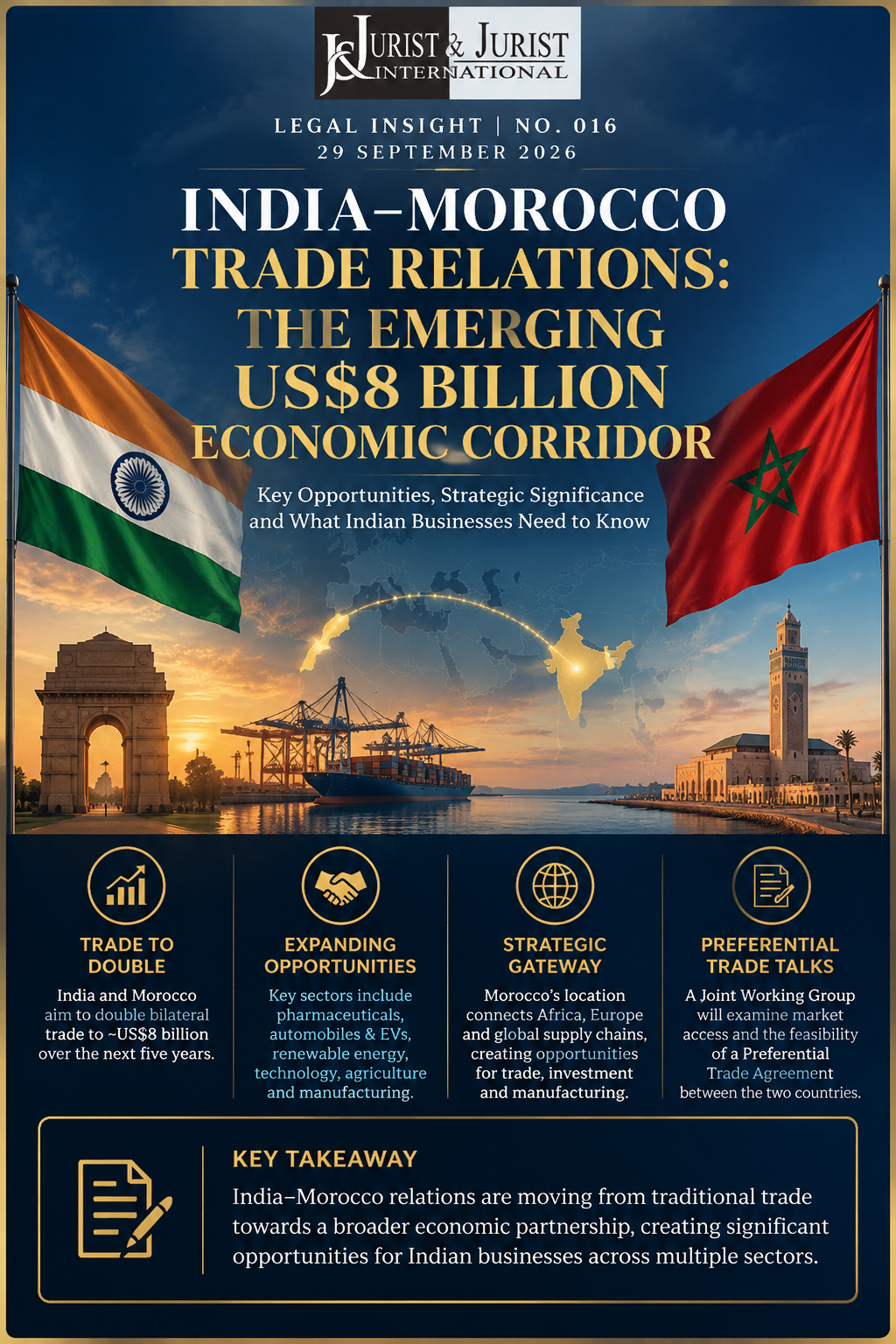
Why Morocco’s strategic location, industrial ecosystem and expanding economic partnership with India could create new opportunities for trade, investment and cross-border business
India and Morocco are quietly building one of India’s more interesting commercial relationships in North Africa.
At the 7th Session of the India–Morocco Joint Commission held in August 2026, the two countries agreed to work towards doubling bilateral trade over the next five years. With bilateral trade presently around US$4 billion, the ambition could take India–Morocco commerce towards approximately US$8 billion.
The number is significant. But the more important story lies behind it.
The emerging relationship is no longer confined to conventional import and export transactions. India and Morocco are looking at wider cooperation involving manufacturing, pharmaceuticals, automobiles and EV components, renewable energy, technology, agriculture, fertilisers, healthcare, digital businesses and investment.
For Indian businesses looking beyond traditional international markets, Morocco therefore deserves closer attention—not merely as another export destination, but potentially as a strategic commercial base connecting Africa, Europe and global supply chains.
Why Is Morocco Strategically Important for Indian Businesses?
Morocco occupies an unusual economic position.
Situated at the north-western edge of Africa, with proximity to Europe and access to Atlantic and Mediterranean trade routes, the country has progressively developed itself as a manufacturing, logistics and export-oriented economy.
Its importance is strengthened by its commercial relationships with major international markets, including the European Union and the United States, as well as its position within the wider African economic landscape.
This creates an important distinction. An Indian company may look at Morocco simply as a market of consumers. A more strategic business may examine whether Morocco could form part of its manufacturing, sourcing, distribution or Africa–Europe expansion strategy.
However, establishing operations in Morocco does not automatically give an Indian business preferential access to third-country markets. Such benefits depend upon applicable trade agreements, rules of origin, local value addition, customs classifications and other regulatory requirements. That distinction is critical when designing any cross-border investment strategy.
India–Morocco Trade: From Commodities to a Diversified Economic Partnership
Historically, an important foundation of India–Morocco trade has been phosphates, phosphoric acid and fertilisers. Morocco possesses substantial phosphate resources, while India has significant agricultural and fertiliser requirements. This created a natural economic complementarity between the two countries.
The relationship, however, is becoming considerably broader. India’s exports and commercial interests increasingly extend into areas such as engineering products, automobiles and auto components, machinery, chemicals, pharmaceuticals, textiles, electrical equipment and other manufactured products.
The August 2026 discussions signal an intention to accelerate this diversification. The sectors identified for deeper cooperation include pharmaceuticals and healthcare; automobiles and EV components; fertilisers and chemicals; renewable energy and energy storage; artificial intelligence and digital technologies; machinery and electrical equipment; agriculture and food products; minerals and metals; construction materials; tourism and services; and industrial and manufacturing cooperation.
This matters because diversified trade creates a different kind of economic relationship. Instead of merely selling goods across borders, businesses begin establishing distributors, subsidiaries, joint ventures, technology partnerships, manufacturing arrangements and long-term supply chains. That is where bilateral trade begins evolving into a genuine economic corridor.
The US$8 Billion Target Is Only Part of the Story
The commitment to double trade naturally attracts attention. But businesses should pay equal attention to another development arising from the Joint Commission.
India and Morocco agreed to establish a Joint Working Group to examine bilateral trade opportunities and the feasibility of a Preferential Trade Agreement (PTA). A preferential trade arrangement can potentially reduce tariffs for agreed categories of goods and improve commercial access between participating countries.
The proposed mechanism is expected to examine tariff barriers, non-tariff barriers, market access, trade facilitation, and goods and services.
At present, this should be understood as an exploratory process rather than a concluded trade agreement. Nevertheless, it is commercially significant. If negotiations eventually result in preferential arrangements, businesses operating in sectors covered by such concessions could experience changes in landed costs, sourcing decisions and competitiveness. Indian exporters considering Morocco should therefore follow the development of these negotiations rather than waiting until an agreement is ultimately implemented.
Pharmaceuticals and Healthcare: A Particularly Important Opportunity
India’s pharmaceutical capabilities and Morocco’s expanding healthcare requirements create another area of commercial complementarity. During the 2026 discussions, regulatory and market-access issues concerning Indian pharmaceutical companies received specific attention.
For Indian pharmaceutical and healthcare businesses, the opportunity may therefore extend beyond simply exporting medicines. Potential commercial structures could include export, local distribution, product registration, strategic partnerships, and local manufacturing or joint ventures. Medical devices, diagnostics, digital healthcare and related technologies could similarly become areas of greater cooperation.
However, pharmaceuticals demonstrate why international market expansion cannot be approached merely as a sales exercise. A successful entry strategy may require analysis of product registration, licensing, regulatory approvals, local distribution arrangements, intellectual-property protection, product liability and contractual risk allocation.
Automobiles, EVs and Manufacturing
Morocco has developed an increasingly important automotive manufacturing ecosystem. India, meanwhile, has substantial capabilities in automotive components, engineering and the emerging electric-mobility supply chain. The identification of automotive value chains and EV components as areas for cooperation is therefore commercially significant.
For Indian manufacturers, participation may progress from exports and component supply to technical collaboration, local assembly, manufacturing and regional distribution. Each stage creates a different legal and financial structure. A straightforward component export may principally require a strong international supply agreement and payment security. A manufacturing joint venture could additionally involve foreign investment rules, corporate structuring, intellectual property, technology licensing, taxation, employment, land, regulatory approvals and mechanisms for resolving shareholder disputes.
Renewable Energy and Technology Could Define the Next Phase
Perhaps the most forward-looking part of the India–Morocco relationship lies in sectors such as renewable energy, energy storage, artificial intelligence, fintech and digital transformation.
For Indian technology, engineering and renewable-energy companies, Morocco could present opportunities involving solar and renewable-energy projects, energy-storage technologies, engineering services, software solutions, artificial intelligence, fintech platforms, industrial technology and digital infrastructure.
These transactions are rarely simple export contracts. They may involve technology licensing, intellectual-property ownership, data governance, project financing, local partnerships, service-level obligations and long-term commercial arrangements. For businesses exploring such opportunities, commercial negotiations and legal structuring should therefore develop simultaneously.
Agriculture and Food Trade: Regulation Matters as Much as Demand
India and Morocco have also moved towards closer cooperation concerning food safety and agricultural trade. An MoU between India’s Food Safety and Standards Authority of India (FSSAI) and Morocco’s National Office of Food Safety (ONSSA) creates a framework for regulatory cooperation and exchange of technical expertise.
This illustrates an important principle of international trade: market demand does not necessarily mean market access. A food or agricultural product may have willing buyers abroad and still encounter difficulties involving
sanitary and phytosanitary requirements, certification, labelling, packaging, testing or product standards. Businesses entering new markets therefore need to examine regulatory barriers alongside commercial demand.
What Should an Indian Company Examine Before Entering Morocco?
The announcement of stronger bilateral relations should not itself be treated as an investment strategy. Before entering any foreign jurisdiction, an Indian business should first determine what commercial model it actually intends to pursue.
The progression could look very different depending upon the objective: exporting from India; appointing a Moroccan distributor or commercial partner; opening a local business presence; entering a joint venture; establishing manufacturing operations; or using Morocco within a wider Africa–Europe strategy.
Each model has different implications. Businesses should examine market-entry structure, due diligence on counterparties, foreign-investment requirements, tax and customs consequences, rules of origin, intellectual-property protection, payment security, contractual protections and dispute-resolution mechanisms. These questions can determine whether an international expansion becomes commercially sustainable or creates avoidable cross-border exposure.
The Contract Becomes the Commercial Architecture
International businesses sometimes treat the contract as documentation to be completed after the commercial deal has already been negotiated. That approach can be particularly risky in cross-border transactions.
The contract determines who carries commercial risk, when ownership transfers, who bears customs and transportation costs, how payment is secured, who owns technology and intellectual property, what happens after termination, which country’s law applies and where a dispute will ultimately be decided.
For substantial India–Morocco transactions, legal structuring should therefore begin during commercial negotiations rather than after them. A typical transaction may progress through commercial discussion, term sheet or MoU, due diligence, transaction structure, regulatory review, definitive agreements, closing, and ongoing compliance and performance.
Morocco as a Gateway: An Opportunity That Requires Careful Structuring
It is tempting to describe Morocco simply as a “gateway to Africa.” The commercial reality is more nuanced—and more interesting.
Morocco’s geography, industrial infrastructure, international trade relationships and developing manufacturing ecosystem may make it useful as part of a wider international strategy. But businesses must determine whether that strategy actually works for their particular product.
Questions concerning rules of origin, customs treatment, local value addition, taxation, logistics and regulatory compliance need to be examined before assuming that manufacturing or establishing operations in Morocco will provide access to another market. The opportunity therefore lies not merely in choosing Morocco as a location, but in structuring the Moroccan operation correctly.
India–Morocco: A Relationship Worth Watching
The ambition to double India–Morocco bilateral trade to approximately US$8 billion over five years should be viewed as more than a trade statistic. It reflects a wider movement towards deeper economic integration involving trade, investment, manufacturing, technology, energy and regulatory cooperation.
For Indian businesses, Morocco may increasingly become relevant in three different capacities: as a market for Indian goods and services; as an investment and manufacturing destination for Indian companies; and as a potential strategic platform within wider African and international supply chains.
The businesses most likely to benefit will be those that understand the market, identify the correct partners, structure the transaction carefully and protect themselves against regulatory, contractual and cross-border risks.
Legal & Business Takeaway
The India–Morocco relationship is moving from bilateral trade towards broader economic partnership. The proposed expansion of trade, examination of a preferential trade arrangement and cooperation in pharmaceuticals, automobiles, EVs, renewable energy, technology and agriculture can create meaningful opportunities for Indian and Moroccan enterprises.
For businesses exploring this corridor, the starting point should therefore not simply be: “What can we sell?”
The more valuable questions are: Where should we establish ourselves? Who should we partner with? How should the transaction be structured? How will our investment, technology and payments be protected? And how can the relationship become part of a wider international growth strategy?
Those questions turn an export opportunity into an international business strategy.
About Jurist & Jurist International Law Firm
Jurist & Jurist International Law Firm, a corporate law firm in Delhi, advises Indian and international businesses on corporate and commercial transactions, cross-border contracts, foreign investment, joint ventures, regulatory matters, international business arrangements and dispute resolution.
The Firm assists businesses in structuring international transactions from the initial commercial framework and due diligence through contractual documentation, regulatory strategy, risk allocation and international dispute-resolution mechanisms.
This Knowledge Article is published for general information and knowledge sharing only and should not be construed as legal advice.
India–Morocco Trade Relations 2026 | US$8 Billion Trade & Investment Opportunities
India and Morocco aim to double bilateral trade to nearly US$8 billion. Explore opportunities for Indian businesses in pharmaceuticals, EVs, renewable energy, manufacturing, technology and cross-border investment.
India Morocco trade relations
India Morocco bilateral trade; India Morocco trade 2026; India Morocco business opportunities; Morocco investment opportunities for Indian companies; India Africa trade; cross-border investment India Morocco; international business law India; corporate law firm in Delhi; international lawyer in Delhi; Best Corporate Law Firm in Delhi.
Copyright © 2012-2025. Jurist & Jurist International is a registered trademark. Unauthorized use, reproduction, or imitation of our name, logo, or design is strictly prohibited and punishable under applicable laws.
Designed by RICKYTECH & CO.