
WhatsApp us on +91 9091913999 or Call us on +91 9811881981
LEGAL INSIGHT 009 | 09 OCTOBER 2026 When Commercial Opportunity Conflicts with Contractual Obligations: The Galp–Venture Global Arbitration
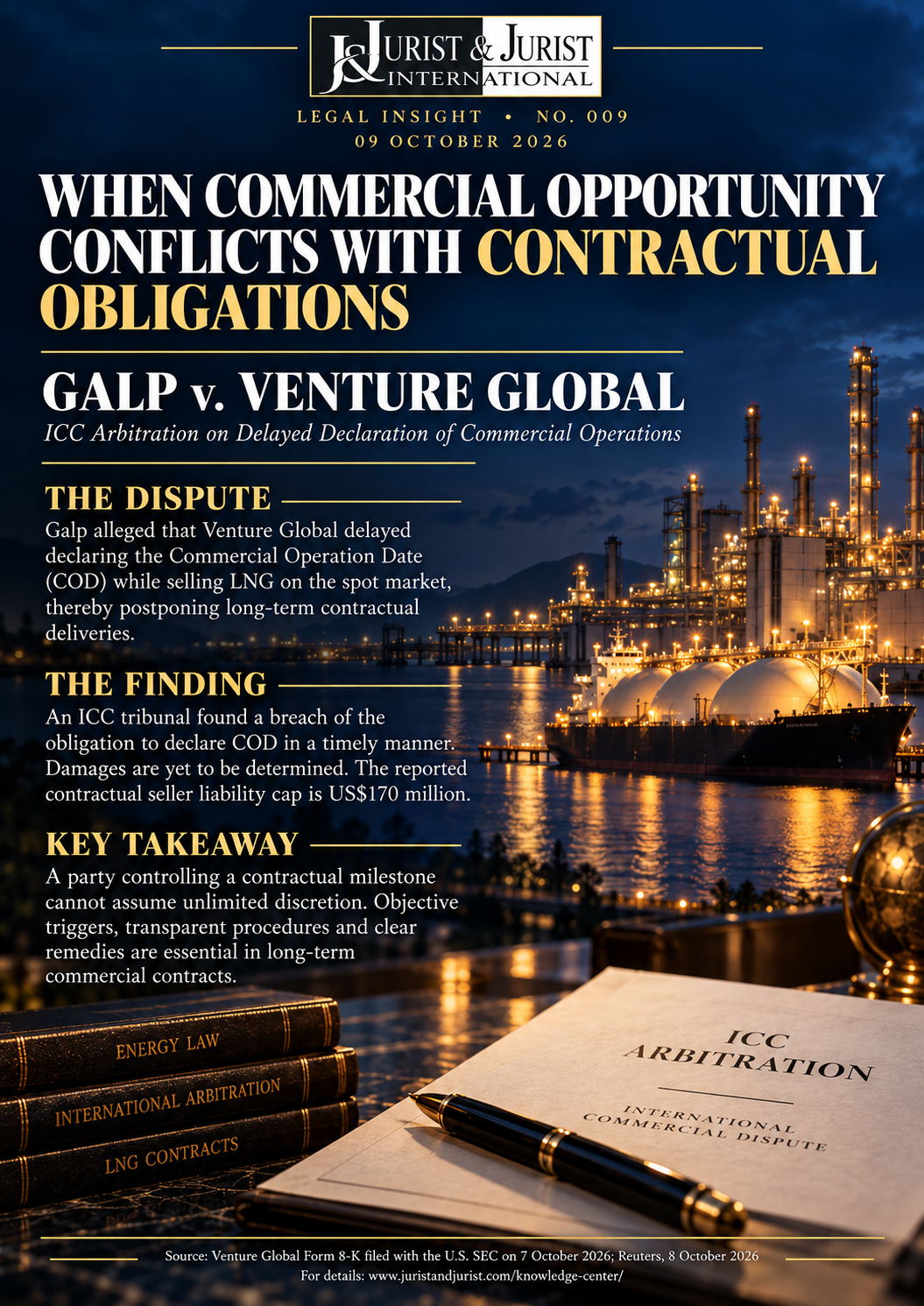
An international arbitration dispute highlights why contractual milestones, commercial discretion and timely performance are critical to long-term business agreements.
The Dispute: Can Commercial Operations Be Delayed While Business Continues?
In a significant development in international commercial arbitration, an arbitral tribunal constituted under the International Chamber of Commerce (ICC) framework has found that Venture Global Calcasieu Pass, LLC breached its contractual obligation to declare the Commercial Operation Date (COD) of its liquefied natural gas (LNG) project in a timely manner under its long-term Sale and Purchase Agreement (SPA) with Portugal’s Galp Trading S.A.
The partial final award was communicated on 7 October 2026, as confirmed in Venture Global’s regulatory disclosure filed with the U.S. Securities and Exchange Commission (SEC).
The dispute arose from the Calcasieu Pass LNG project in Louisiana, United States. Venture Global had entered into long-term supply arrangements with international energy buyers, including Galp, under which contractual deliveries were linked to the commencement of commercial operations.
However, while the project continued its commissioning process, Venture Global sold LNG in the spot market during a period of exceptionally high international energy prices. Several contractual buyers alleged that delayed declaration of commercial operations prevented them from receiving LNG under their long-term agreements, while Venture Global benefited from comparatively favourable spot-market conditions.
Venture Global disputed these allegations, maintaining that operational and technical conditions prevented an earlier declaration of commercial operations. The central controversy was therefore whether the supplier had complied with its contractual obligation to declare commercial operations at the appropriate time—not merely whether LNG was being produced or sold.
The Arbitral Finding: Breach Established, Damages Yet to Be Determined
The arbitral tribunal, acting by majority, determined that Venture Global had failed to fulfil its obligation to declare COD in a timely manner under the Galp agreement. One of the three arbitrators dissented from the majority’s finding.
Importantly, the tribunal has not yet quantified compensation. A separate hearing concerning remedies is anticipated in 2027 or 2028. According to the company’s SEC disclosure, eventual recovery is subject to a US$170 million aggregate seller liability cap contained in the agreement. This amount is a contractual limit—not damages already awarded.
The decision does not terminate the existing supply relationship. Venture Global reported that the Calcasieu project achieved COD on 15 April 2025 and that 20 LNG cargoes had subsequently been delivered to Galp. This distinguishes a finding of breach from financial recovery and continuing contractual performance.
The Broader Legal Question: Does Control Over a Milestone Confer Unlimited Discretion?
Many commercial contracts make payment, delivery, revenue sharing, performance guarantees or other obligations dependent upon specified milestones, such as commissioning, commercial operations, regulatory approval or project completion. Where one party substantially controls the determination or declaration of that milestone, disputes may arise concerning the timing and legitimacy of its decision.
A contractual right to declare a milestone does not necessarily amount to an unrestricted right to postpone it. The extent of discretion depends on contractual wording, governing law, objective performance conditions and the parties’ duties. The full Galp award was not publicly available in the materials reviewed; therefore, its precise reasoning—including any application of good faith or prevention principles—cannot responsibly be asserted.
Why Similar Disputes Produced Different Arbitration Outcomes
Separate arbitral tribunals have reached different conclusions concerning the same LNG development. In October 2025, a tribunal found a breach in proceedings involving BP, while tribunals rejected claims by Shell and Repsol in other proceedings. This illustrates that commercial similarity does not establish contractual or legal identity.
Outcomes can differ because of the language of the individual agreements, the governing standards of performance, factual evidence and the legal issues submitted for adjudication. Each contract therefore warrants independent review rather than an assumption that a result in a related arbitration will automatically apply.
Legal Implications for International Businesses
Objective milestones. Commissioning, completion and operational-readiness conditions should identify measurable triggers, certification procedures and time limits.
Contractual commitments. More profitable market opportunities do not, by themselves, release a party from existing delivery or performance obligations.
Documentary evidence. Technical reports, commissioning records, project correspondence, third-party certifications and contemporaneous operational information can be decisive.
Liability allocation. Limitation clauses, exclusions, damages provisions and liability caps require careful pre-contract negotiation.
Liability versus damages. Proving breach does not itself quantify compensation; causation, loss, contractual restrictions and governing law may require separate determination.
Relevance to Indian Corporate and Commercial Contracts
The underlying issues apply to Indian businesses engaged in construction, infrastructure, manufacturing, cross-border trade and long-term supply arrangements. Similar disputes may arise when EPC contractors delay commissioning certificates, suppliers postpone deliveries, developers control completion milestones or payments depend upon operational approvals.
Depending on the facts and contractual structure, Sections 53, 54, 73 and 74 of the Indian Contract Act, 1872 may be relevant to reciprocal promises, prevention of performance and compensation for breach. The Galp award does not itself interpret Indian law; it offers a practical comparison for examining milestone-based obligations and remedies.
Legal Takeaway
The real significance of the Galp–Venture Global arbitration lies in the relationship between commercial discretion and contractual accountability. A party’s control over a contractual milestone may not protect it from liability where delay breaches its agreement. At the same time, differing results in related arbitrations confirm that liability must be established under the particular contract and evidentiary record.
For businesses entering long-term agreements, the essential safeguard is not simply defining what must be performed, but specifying when performance becomes due, who determines the milestone, how compliance is verified and what remedy follows from delay.
About Jurist & Jurist International Law Firm
Jurist & Jurist International Law Firm is an India-based law firm advising businesses and institutions on corporate and commercial law, international business transactions, contractual disputes, regulatory compliance and domestic and international arbitration. The firm focuses on strengthening contractual frameworks and protecting commercial interests in domestic and cross-border relationships.
Knowledge Centre: https://www.juristandjurist.com/knowledge-center/
Primary Sources and References
Venture Global Inc., Form 8-K regulatory disclosure concerning the Galp arbitration, October 2026 — SEC EDGAR: https://www.sec.gov/edgar/browse/?CIK=2007855&owner=exclude
Venture Global Inc., official corporate disclosures and statements concerning the Calcasieu Pass arbitrations: https://ventureglobal.com/
Reuters, reporting of 8 October 2026 concerning the Galp–Venture Global arbitration.
Research note: Based on publicly available company/regulatory disclosures and reporting as of 9 October 2026. The underlying confidential ICC award was not independently examined.
Copyright © 2012-2025. Jurist & Jurist International is a registered trademark. Unauthorized use, reproduction, or imitation of our name, logo, or design is strictly prohibited and punishable under applicable laws.
Designed by RICKYTECH & CO.