
WhatsApp us on +91 9091913999 or Call us on +91 9811881981
LEGAL INSIGHT 010 | 10 OCTOBER 2026 When an Arbitration Award Does Not End the Dispute: Lessons from the Tocumen–Odebrecht Case
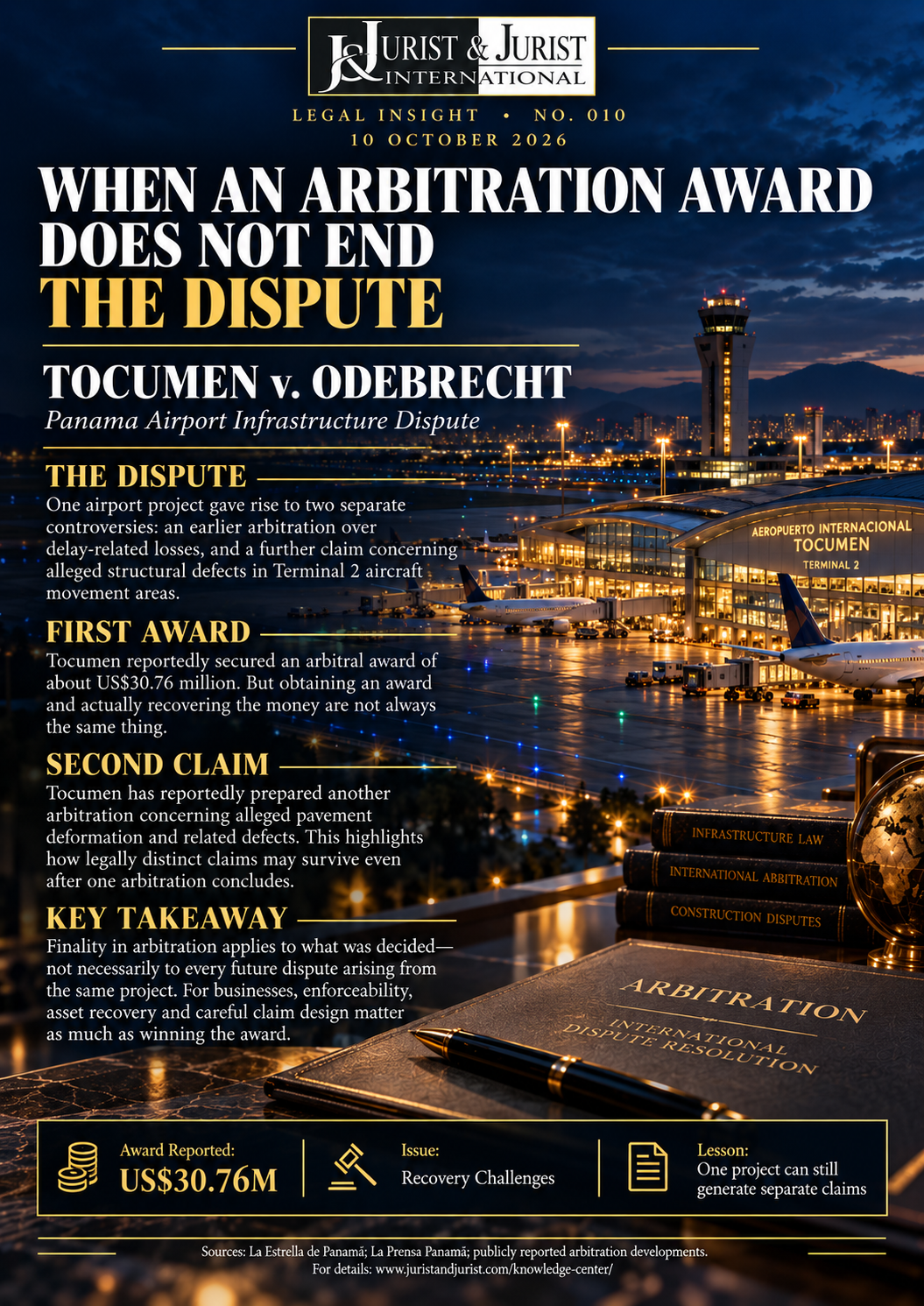
The Panama airport controversy highlights how successive claims, construction defects and difficulties in recovering arbitral awards can complicate international commercial dispute resolution.
The Dispute: One Infrastructure Project, Two Arbitration Claims
An arbitral award is generally intended to bring finality to a commercial dispute. However, does the conclusion of one arbitration necessarily prevent further proceedings arising from the same contractual relationship?
The continuing dispute between Tocumen International Airport in Panama and Brazilian construction group Odebrecht, subsequently operating as CNO S.A., illustrates why the answer is not always straightforward.
The controversy originates from the construction of Terminal 2 at Tocumen International Airport. The project, initially contracted in 2012 for approximately US$679 million, subsequently experienced delays, contractual disagreements and concerns surrounding the quality of certain construction works.
These disputes led to arbitration proceedings in which Tocumen secured an award of approximately US$30.76 million. However, the airport operator has reportedly faced difficulties recovering the awarded amount. In September 2026, Tocumen began preparing another arbitration concerning alleged structural defects affecting aircraft movement areas associated with the same terminal.
The central legal question is how parties can preserve the finality of an arbitral award while retaining legitimate rights to pursue separate contractual breaches.
The First Arbitration: Liability Determined, Recovery Unresolved
The earlier arbitration arose from contractual disagreements concerning project delays and related financial losses. In 2024, an arbitral tribunal administered through Panama’s Centre for Conciliation and Arbitration reportedly awarded Tocumen approximately US$30.76 million, including compensation for lost profits and damages.
Although the contractor challenged the decision, the award reportedly survived judicial scrutiny in October 2025. Nevertheless, recovery of the compensation has remained difficult, with public reports identifying concerns regarding the contractor’s financial circumstances and the availability of recoverable assets.
An arbitral award may establish an enforceable financial entitlement without guaranteeing that the successful party will actually receive payment.
The Second Arbitration: A New Claim Arising from the Same Project
In September 2026, Tocumen disclosed that it was preparing a further arbitration concerning alleged deficiencies in aircraft apron and circulation areas connected with Terminal 2. The reported defects include pavement deformation and problems affecting areas used for aircraft movement. Management stated that approximately US$6 million had been spent on maintenance and repairs over the preceding two and a half years.
According to Tocumen’s legal adviser, María Teresa Ponce, the airport notified the contractor and initiated negotiations. Following the failure to reach an agreement, preparations began for a separate arbitration. This is a proposed claim, not a second arbitral award; liability for the alleged defects has not been determined.
The Central Legal Issue: Can the Same Contract Give Rise to Successive Arbitrations?
The most significant legal issue concerns the distinction between the finality of an arbitral award and the survival of separate contractual claims. Res judicata seeks to prevent matters already conclusively determined from being litigated again. Its application does not necessarily prevent every subsequent arbitration arising from the same commercial relationship.
A claim for losses resulting from delayed completion may be legally distinct from a claim concerning defective construction discovered or pursued separately. Whether a subsequent arbitration is permissible depends on the scope of the earlier award, the obligations allegedly breached, identity of the claims, applicable limitation periods and governing preclusion rules.
The earlier arbitration may have resolved the financial consequences of delay without necessarily deciding every question about construction quality. Without reviewing the award and proposed claim, however, it would be premature to conclude that a second proceeding is admissible.
The essential principle is that an arbitral award provides finality to matters it determines, but does not automatically extinguish every separate right arising from the same contract.
The Practical Challenge: Winning an Award Versus Recovering Compensation
Even after obtaining a favourable award and defending it against a judicial challenge, a claimant may face substantial difficulty recovering compensation. Tocumen’s representatives reportedly identified the debtor’s financial circumstances, available assets and competing creditors as relevant obstacles.
The 1958 New York Convention supplies an internationally recognised mechanism for recognising and enforcing qualifying foreign arbitral awards. Yet recognition and enforcement cannot guarantee payment if the debtor lacks sufficient executable assets. The available reporting does not establish that Tocumen’s present recovery efforts involve foreign enforcement under the Convention; its relevance here is as a broader lesson for international transactions.
What Can International Businesses Learn?
First, contractual rights must be clearly preserved beyond project completion where appropriate. Defect-liability periods, warranties, technical acceptance conditions and post-completion obligations should be precisely documented.
Second, successive claims demand careful legal distinction. Parties should identify the precise breaches, remedies and issues previously adjudicated, while considering limitation rules, preclusion and the risk of double recovery.
Third, financial security must form part of contractual risk allocation. Performance guarantees, retention arrangements, parent-company guarantees and appropriately structured insurance may protect against non-payment after an award.
Legal Takeaway
The Tocumen–Odebrecht dispute demonstrates that the conclusion of one arbitration does not necessarily mark the end of a commercial conflict. An award may conclusively resolve one set of obligations while separate claims remain, and even a successful award may offer limited practical relief where the losing party lacks recoverable assets.
For international businesses, effective arbitration begins with sound contractual risk allocation and ends only when legal rights can be translated into meaningful commercial relief. The true measure of arbitration is not simply whether a party wins, but whether it delivers an enforceable, financially effective and sufficiently comprehensive resolution.
About Jurist & Jurist International Law Firm
Jurist & Jurist International Law Firm advises businesses and institutions on international commercial law, cross-border transactions, infrastructure and construction disputes, contractual risk management, and domestic and international arbitration. Through its Legal Insight series, the firm examines significant legal developments and their commercial implications.
Sources and References
- La Estrella de Panamá, “Tocumen prepara arbitraje contra Odebrecht por ruinas en la Terminal 2” (September 2026): https://www.laestrella.com.pa/panama/nacional/tocumen-prepara-arbitraje-contra-odebrecht-por-ruinas-en-la-terminal-2-EA25618059
- La Prensa Panamá, report on US$30.76 million arbitral award (August 2024): https://www.prensa.com/economia/odebrecht-condenada-a-pagar-mas-de-30-millones-a-tocumen-por-demanda-por-la-terminal-2/
- TVN Panamá, reporting on the arbitral award (August 2024): https://www.tvn-2.com/nacionales/norberto-odebrecht-s-a-aeropuerto-de-tocumen-arbitraje-terminal-2_1_2153244.html
- Convention on the Recognition and Enforcement of Foreign Arbitral Awards (1958): https://www.newyorkconvention.org/
Research note: The full arbitral award and challenge decision have not been independently examined. The second arbitration is reported as contemplated, not decided. The general discussion of international arbitration principles is analytical and not attributed to the first tribunal.
Copyright © 2012-2025. Jurist & Jurist International is a registered trademark. Unauthorized use, reproduction, or imitation of our name, logo, or design is strictly prohibited and punishable under applicable laws.
Designed by RICKYTECH & CO.