
WhatsApp us on +91 9091913999 or Call us on +91 9811881981
LEGAL INSIGHT 015 | 15 OCTOBER 2026 CAN PRIOR STATE REPRESENTATION DISQUALIFY AN ARBITRATOR?
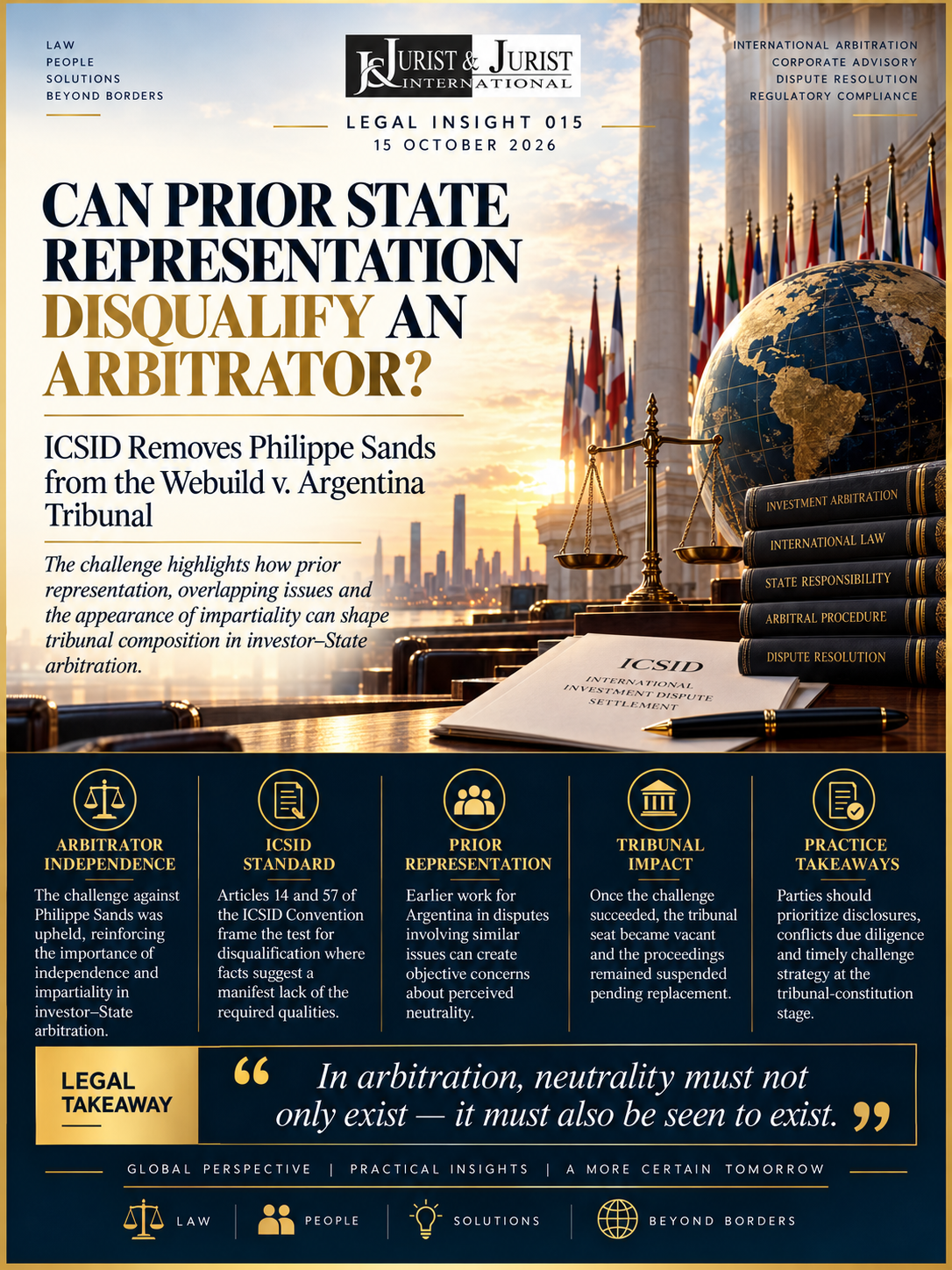
ICSID Upholds Challenge Against Philippe Sands in Webuild v. Argentina — Renewing the Debate on Arbitral Independence, Impartiality and Conflicts of Interest
International Investment Arbitration | Arbitrator Disqualification | Investor–State Dispute Settlement
A Significant Development in International Investment Arbitration
The independence and impartiality of arbitrators remain fundamental to the legitimacy of international investment arbitration. In a notable development, the unchallenged members of an International Centre for Settlement of Investment Disputes (ICSID) tribunal have upheld a proposal seeking the disqualification of internationally recognised arbitrator Professor Philippe Sands, KC, in Webuild S.p.A. v. Argentine Republic (ICSID Case No. ARB/26/7).
On 9 October 2026, the two unchallenged co-arbitrators upheld the disqualification proposal, resulting in a vacancy on the tribunal and continued suspension of the proceedings. The development has attracted particular attention because the reported challenge concerned Professor Sands’ previous representation of Argentina in investment disputes involving similar material facts and legal issues.
The case raises an important question extending beyond the immediate dispute: when can an arbitrator’s previous professional representation of a sovereign State give rise to objectively justified concerns regarding independence and impartiality in subsequent investment arbitration proceedings?
Background: Webuild S.p.A. v. Argentine Republic
The underlying arbitration involves Italian construction company Webuild S.p.A. and the Argentine Republic, arising from a highway construction concession in Argentina. The proceeding was registered on 2 February 2026 under the 1990 Argentina–Italy Bilateral Investment Treaty.
The tribunal was constituted on 27 July 2026, comprising Sean Murphy as President, Stephan Schill as claimant-appointed arbitrator and Philippe Sands as respondent-appointed arbitrator. On the same date, Webuild submitted a proposal challenging Professor Sands’ appointment under Rule 22 of the ICSID Arbitration Rules. The arbitration was consequently suspended while the challenge was examined.
Following observations from Argentina, a statement from Professor Sands and further submissions by the parties, the unchallenged arbitrators upheld the proposal on 9 October 2026. The publicly available ICSID case record establishes the procedural outcome. However, the complete reasoned disqualification decision was not available in the official materials reviewed.
The Central Legal Question: Does Prior Representation Compromise Neutrality?
The reported challenge centred on Professor Sands’ earlier professional engagements representing Argentina in investment arbitration proceedings. ICSID’s official professional database identifies his previous involvement as counsel for Argentina in matters including Siemens A.G. v. Argentine Republic, Azurix Corp. v. Argentine Republic, CMS Gas Transmission Company v. Argentine Republic and Compañía de Aguas del Aconquija S.A. and Vivendi Universal S.A. v. Argentine Republic.
These engagements illuminate a recurring concern in international arbitration: whether an arbitrator who has previously represented a State in disputes involving overlapping factual circumstances or legal questions can subsequently assess related controversies with the requisite independence.
Importantly, previous representation of a party is not, by itself, an automatic ground for disqualification. Experienced international arbitration practitioners routinely act in different professional capacities.
The legal concern becomes more substantial where the nature of the earlier engagement, the arbitrator’s exposure to particular facts or evidence, or the relationship between the previous and current disputes creates an objectively supportable apprehension that the arbitrator may have prejudged material questions. The crucial distinction is therefore between legitimate professional familiarity and circumstances demonstrating a disqualifying lack of independence or impartiality.
The ICSID Legal Framework: Articles 14, 57 and 58
The power to disqualify an arbitrator in ICSID Convention proceedings derives principally from Articles 14, 57 and 58 of the ICSID Convention.
Article 14(1): Prescribes the professional and personal qualities expected of arbitrators, including the capacity to exercise independent judgment.
Article 57: Permits a party to propose disqualification on account of facts indicating a manifest lack of the qualities required under Article 14(1), or ineligibility under the Convention’s appointment requirements.
Article 58: Provides the mechanism for deciding such challenges, ordinarily entrusting the decision to the unchallenged tribunal members where a single arbitrator is challenged.
Under ICSID Arbitration Rule 22, a challenge must generally be submitted within 21 days after the later of tribunal constitution or the date on which the challenging party knew, or should have known, the relevant facts. Filing the proposal ordinarily suspends proceedings pending its determination.
The applicable standard is objective. It requires consideration of whether the established facts demonstrate a manifest lack of the required qualities from the perspective of a reasonable third party, rather than merely reflecting a party’s subjective apprehension. Consequently, a successful challenge does not necessarily establish actual bias, misconduct or deliberate prejudgment.
Why the Decision Matters: Five Critical Legal Implications
Arbitrator independence | Prior professional engagements may warrant closer scrutiny where relevant facts or disputed issues materially overlap. |
Disclosure obligations | Meaningful disclosure of relevant previous engagements facilitates informed evaluation of potential conflicts. |
Objective impartiality | The disqualification inquiry focuses on established circumstances, not merely a party’s subjective perception. |
Party-appointed arbitrators | Nomination by a disputing party does not diminish the arbitrator’s duty to exercise independent judgment. |
Procedural consequences | A successful challenge may necessitate tribunal reconstitution, delay the proceedings and increase dispute-resolution costs. |
The development also emphasises the practical importance of early conflict-of-interest due diligence. Parties and counsel should examine not only an arbitrator’s current relationships but also relevant previous appointments, counsel engagements and connections with disputed governmental measures or evidence.
Jurist & Jurist International | Legal Perspective
The Webuild v. Argentina development reflects an increasingly important tension within international arbitration: the value of specialised professional experience must be reconciled with the uncompromising requirement of independent adjudication.
As the international arbitration community remains relatively specialised, experienced practitioners frequently encounter recurring States, investment treaties and regulatory controversies. Such professional exposure can strengthen expertise, but it also requires careful examination where successive engagements involve substantially related questions.
First, an arbitrator’s previous professional engagement cannot be viewed in isolation. Its relevance must be evaluated in the context of the specific dispute, including the nature of the earlier representation and its connection with the issues presently requiring adjudication.
Second, the distinction between actual bias and an objectively established appearance of compromised impartiality remains central to arbitral integrity. The protection of procedural fairness should not depend exclusively upon proof of actual prejudgment.
Third, effective conflict management must begin before tribunal constitution. Comprehensive professional due diligence, timely disclosures and appropriately supported challenges are essential safeguards against avoidable procedural disruption.
The decision should therefore not be interpreted as establishing a universal prohibition against appointing former counsel for a sovereign State. Rather, it underscores the necessity of conducting an individualised and evidence-based assessment under the applicable ICSID standard.
Conclusion: Independence Must Prevail Over Appointment
The successful challenge against Professor Philippe Sands in Webuild S.p.A. v. Argentine Republic reinforces the continuing importance of arbitrator independence in investor–State dispute settlement.
While previous professional representation does not automatically establish disqualification, sufficiently significant connections between past engagements and disputed questions may justify closer examination under the ICSID Convention.
For foreign investors, sovereign States and international arbitration practitioners, the development offers a wider institutional lesson: the legitimacy of arbitration depends not only upon the expertise of those appointed to decide disputes, but also upon the demonstrable independence of their judgment.
The outcome serves as a reminder that party autonomy in appointing arbitrators operates within the fundamental requirements of fairness, independence and impartiality.
Legal Takeaway
“In international arbitration, neutrality must not only exist — it must also be seen to exist.”
The Webuild v. Argentina development underscores why prior professional engagements, material overlaps in disputed issues and transparent conflict assessment are central to maintaining confidence in international dispute resolution.
Official Legal Sources
- ICSID — Webuild S.p.A. v. Argentine Republic, Case No. ARB/26/7: https://icsid.worldbank.org/cases/case-database/case-detail?CaseNo=ARB%2F26%2F7
- ICSID — Disqualification of Arbitrators under the 2022 Rules: https://icsid.worldbank.org/procedures/arbitration/convention/disqualification/2022
- ICSID Arbitration Rules 2022, Rules 22–26: https://icsid.worldbank.org/rules-regulations/convention/arbitration-rules/chapter-iii-disqualification-of-arbitrators-and-vacancies
- ICSID — Professor Philippe Sands, Professional Record: https://icsid.worldbank.org/resources/databases/arbitrators-conciliators-ad-hoc-committee-members/profile?cvid=515
Editorial note: The official ICSID sources confirm the successful challenge, the parties’ submissions and procedural consequences. The specific relationship between earlier representation and overlapping factual or legal issues is reported in specialist coverage; the full reasoning has not been independently verified from a publicly accessible decision. The legal assessment above is the firm’s independent analysis rather than a representation of unpublished tribunal findings.
JURIST & JURIST INTERNATIONAL LAW FIRM
Global Perspective | Practical Insights | A More Certain Tomorrow
Legal Insight 015 | 15 October 2026
Disclaimer: This publication is intended exclusively for legal research, professional knowledge and general information. It does not constitute legal advice.
Copyright © 2012-2025. Jurist & Jurist International is a registered trademark. Unauthorized use, reproduction, or imitation of our name, logo, or design is strictly prohibited and punishable under applicable laws.
Designed by RICKYTECH & CO.