
WhatsApp us on +91 9091913999 or Call us on +91 9811881981
LEGAL INSIGHT NO. 012 25 September 2026 CAN ECONOMIC SANCTIONS AMOUNT TO EXPROPRIATION OF A FOREIGN INVESTMENT?
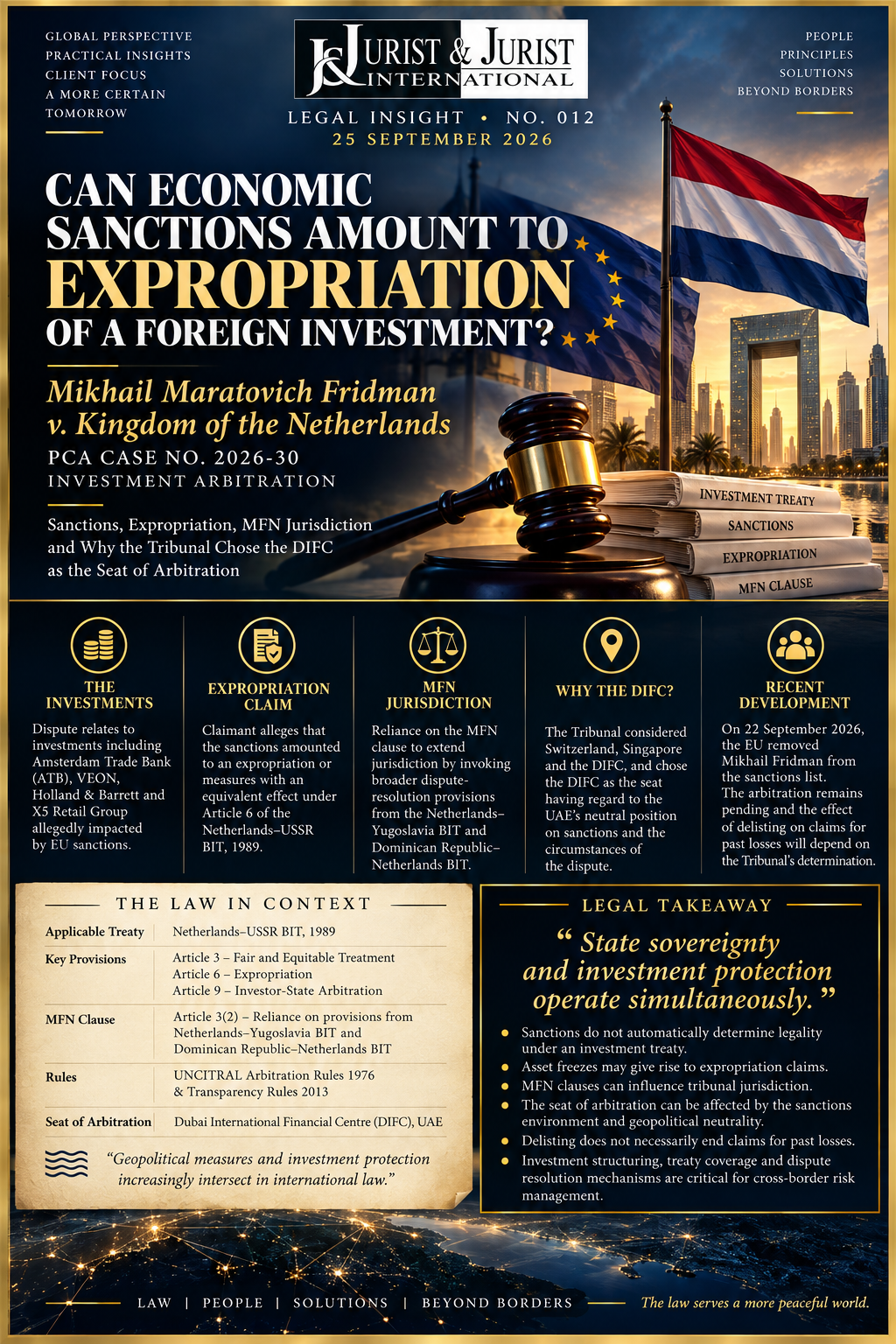
Mikhail Maratovich Fridman v. Kingdom of the Netherlands
PCA Case No. 2026-30 | Investment Arbitration
International sanctions are generally discussed as instruments of foreign policy and national security. But what happens when sanctions imposed upon an individual effectively prevent that person from controlling, using or obtaining economic benefit from investments situated in another State?
Can an asset freeze become an expropriation for the purposes of an investment treaty? Can sanctions allegedly impairing an investment constitute a denial of fair and equitable treatment? Can an investor use a treaty’s Most-Favoured-Nation clause to obtain access to a broader international arbitration mechanism contained in another treaty? And, perhaps most unusually, can sanctions themselves affect where an international arbitration should legally be seated?
These questions lie at the centre of Mikhail Maratovich Fridman v. Kingdom of the Netherlands, PCA Case No. 2026-30—an ongoing investment arbitration concerning the relationship between international sanctions and investment treaty protection.
The dispute remains pending. No tribunal has yet determined that the Netherlands unlawfully expropriated Mr. Fridman’s investments or otherwise breached the applicable treaty. The allegations discussed below are therefore the Claimant’s case, not findings of liability.
THE DISPUTE
Mr. Mikhail Fridman, a Russian and Israeli national, commenced arbitration against the Kingdom of the Netherlands on 26 March 2025.
The proceeding is administered by the Permanent Court of Arbitration (PCA) and arises under the Agreement on Encouragement and Reciprocal Protection of Investments between the Kingdom of the Netherlands and the Union of Soviet Socialist Republics dated 5 October 1989. The Russian Federation is relied upon in the Notice of Arbitration as the continuing State of the USSR for purposes of the Treaty.
The PCA records the proceeding as an investment arbitration in the financial and insurance sector, conducted under the 1976 UNCITRAL Arbitration Rules together with the UNCITRAL Rules on Transparency in Treaty-based Investor-State Arbitration 2013.
The Tribunal comprises Ms. Dyalá Jiménez as Presiding Arbitrator, Prof. Vladimir Pavić as Arbitrator and Mr. J. Christopher Thomas KC as Arbitrator. The case remains pending.
WHAT INVESTMENTS ARE ACTUALLY INVOLVED?
The Notice of Arbitration is important because the dispute is considerably broader than a complaint that personal assets were frozen. Fridman alleges that he held direct or indirect interests in a substantial network of businesses connected with the Netherlands.
Amsterdam Trade Bank N.V. — ATB
ATB was a Dutch bank established in the Netherlands in 1994 and subsequently acquired by Alfa Bank in 2001. According to the Claimant’s case, immediately before its bankruptcy in April 2022, ATB had a balance sheet of approximately EUR 1 billion. Fridman alleges that sanctions fundamentally disrupted the bank’s ability to operate. The Notice relies upon ATB’s bankruptcy position to argue that the bank had substantial assets relative to liabilities and characterises the collapse as arising from sanctions-related operational disruption rather than ordinary commercial insolvency. The Claimant also points to technological and operational consequences, alleging that access to important digital services was affected following the sanctions.
VEON
Fridman also alleges an indirect investment in VEON, the multinational telecommunications and digital services group, through the LetterOne structure. VEON had Dutch entities including Veon Holdings B.V. and Veon Amsterdam B.V., and its shares had traded on Euronext Amsterdam.
Holland & Barrett
The Notice additionally identifies interests connected with Holland & Barrett through the LetterOne investment structure.
X5 Retail Group N.V.
Another significant investment identified is X5 Retail Group N.V., a company organised under Dutch law and headquartered in Amsterdam. The Notice states that Fridman’s indirect interest was held through Luxembourg-based CTF Holdings S.A.
Thus, the arbitration concerns the alleged effect of sanctions upon an interconnected portfolio of investments rather than simply a frozen personal bank account.
FROM SANCTIONS TO AN INVESTMENT-TREATY CLAIM
Following Russia’s military action against Ukraine in February 2022, the European Union imposed restrictive measures against numerous Russian individuals and entities. Fridman became subject to EU restrictive measures, which the Netherlands, as an EU Member State, implemented.
The crucial legal transformation alleged in this arbitration is therefore: EU sanctions → implementation by a State → alleged deprivation or impairment of investments → investment treaty claim against that State.
A measure may have been adopted in pursuit of sanctions or foreign-policy objectives, but that characterisation does not by itself resolve its treatment under an investment treaty. Fridman’s case contends that the effects of the measures must still be tested against the applicable treaty protections. The Netherlands’ ultimate defence and the Tribunal’s eventual determination remain to be seen.
THE EXPROPRIATION CLAIM
The first major substantive allegation arises under Article 6 of the Netherlands–USSR BIT. The Claimant alleges that the adoption and implementation of the relevant measures deprived him of his investments without compensation and therefore constituted expropriation, or alternatively measures having an equivalent effect.
International investment law does not necessarily look only at whether a State formally transferred legal title to itself. An investor may argue that governmental action effectively destroyed or substantially deprived the investor of the use, control or economic benefit of an investment even though formal ownership technically remains. That is the territory of indirect expropriation.
The Fridman arbitration may therefore require examination of a difficult boundary: at what point does an asset freeze or restrictive measure cease to operate merely as regulation and become a compensable deprivation of an investment?
That question is particularly difficult in sanctions cases because the State may invoke significant public-policy, security and international-relations considerations, while the investor may argue that the practical economic effect is indistinguishable from a taking.
FAIR AND EQUITABLE TREATMENT IS A SEPARATE CLAIM
The Notice does not stop with expropriation. Fridman also invokes Article 3(1) of the BIT, which contains protections relating to fair and equitable treatment and measures affecting the operation, management, maintenance, use, enjoyment or disposal of investments.
His case alleges that the sanctions measures were unreasonable and/or discriminatory and impaired his ability to operate, manage, use or enjoy his investments. This distinction matters: even if the Tribunal were ultimately not persuaded that the measures crossed the threshold required for expropriation, questions concerning the treatment of the investor and his investments may still arise separately under the Treaty.
THE JURISDICTIONAL PROBLEM: ARTICLE 9 OF THE 1989 BIT
One of the most technically interesting aspects of the arbitration lies in the Tribunal’s jurisdiction. Article 9(2) of the Netherlands–USSR BIT permits certain disputes concerning the amount or procedure for payment of compensation under Article 6, and certain disputes concerning free transfer, to be referred to international arbitration or conciliation after the stipulated cooling-off period.
That wording creates an important jurisdictional issue: does Article 9 permit the Tribunal itself to decide whether an expropriation occurred, or merely disputes concerning the amount or procedure of compensation once an expropriation has already been established?
Fridman’s Notice argues for the broader interpretation. According to the Claimant, the Tribunal must necessarily be capable of determining whether an expropriation occurred in order to decide a dispute concerning compensation for that expropriation. The Notice, however, advances an alternative jurisdictional route that may prove even more significant.
THE MFN CLAUSE MAY BECOME THE KEY
Article 3(2) of the Netherlands–USSR BIT contains a Most-Favoured-Nation (MFN) clause. In simplified terms, an MFN clause seeks to prevent an investor covered by one treaty from receiving treatment less favourable than investors of third States where the treaty so provides.
Fridman seeks to rely upon Article 3(2) to obtain the benefit of broader investor-State dispute settlement provisions contained in other investment treaties concluded by the Netherlands. The Notice specifically relies upon dispute-resolution provisions in the Netherlands–Yugoslavia BIT and the Dominican Republic–Netherlands BIT, which contain broader language permitting arbitration of disputes connected with an investment.
The Claimant therefore argues that, through the MFN clause, the Tribunal’s jurisdiction extends beyond the potentially narrower wording of Article 9 of the Netherlands–USSR BIT. This raises a classic but contested investment-law issue: can an MFN clause import not merely more favourable substantive treatment, but a more favourable dispute-resolution mechanism from another treaty? The Tribunal has not yet determined that jurisdictional question.
THE PROCEDURAL HISTORY
Fridman notified the Netherlands of the dispute on 22 May 2024. The parties subsequently corresponded and held an unsuccessful meeting on 9 September 2024. After the relevant cooling-off period had elapsed, the Notice of Arbitration was filed on 26 March 2025.
The Claimant initially proposed Hong Kong as the place of proceedings and suggested administration by HKIAC. The eventual decision was different, and it is here that the case becomes particularly important for international arbitration practice.
THE BATTLE OVER THE SEAT OF ARBITRATION
The juridical seat of an arbitration is not merely where lawyers and arbitrators meet. It establishes the arbitration’s legal home and determines the courts that ordinarily exercise supervisory jurisdiction over the arbitration.
In Fridman v. Netherlands, economic sanctions entered directly into that analysis. The Tribunal considered several potential seats, including Switzerland, Singapore and the Dubai International Financial Centre (DIFC), while the Claimant had advocated Hong Kong and alternatively supported the DIFC.
The parties disagreed about the implications of the various jurisdictions. The Claimant argued, among other things, that placing the arbitration in a jurisdiction aligned with sanctions affecting him could create difficulties concerning neutrality, participation, judicial supervision and potentially enforcement. The Netherlands disputed those concerns and raised its own objections to proposed alternative seats.
WHY SINGAPORE WAS NOT SELECTED
Singapore was treated by the Tribunal as a sophisticated and internationally respected arbitral jurisdiction. Nevertheless, the Tribunal considered concerns connected with issues that might arise before Singaporean courts.
In particular, the Tribunal referred to Singapore jurisprudence concerning USSR-era investment treaties and to the unresolved question of whether economic sanctions could engage Singapore public policy in circumstances relevant to enforcement.
The Tribunal did not conclude that Singaporean courts lacked independence or impartiality. Its reasoning was narrower: certain legal questions potentially relevant to this particular dispute were sufficiently live that the Tribunal could not simply disregard them when choosing the juridical seat.
WHY THE DIFC WAS CHOSEN
On 25 May 2026, the Tribunal issued Procedural Order No. 2 — Seat of the Arbitration. The Tribunal considered Singapore and the DIFC to be internationally respected possibilities and then identified a circumstance that tipped the balance: the UAE’s position on sanctions.
Applying Article 16(1) of the 1976 UNCITRAL Arbitration Rules—which requires the Tribunal to determine the place of arbitration having regard to the circumstances of the arbitration—the Tribunal concluded that the circumstances of this particular dispute favoured the DIFC. It specifically referred to the UAE’s neutral position on sanctions and ordered that the DIFC shall be the seat of the arbitration.
Sanctions are therefore operating at two different levels in the same arbitration. Substantively, Fridman alleges that sanctions caused an unlawful deprivation of protected investments. Procedurally, the sanctions environment affected the Tribunal’s determination of the appropriate juridical seat.
THE TRIBUNAL RESERVED A POWER TO REVISIT THE SEAT
Procedural Order No. 2 contains another important feature. The Tribunal recognised that procedural stability is paramount and that changing the seat is not something to be approached casually.
Nevertheless, because of the particular characteristics of the dispute and its broader geopolitical context, the Tribunal expressly reserved the possibility of modifying the seat as a measure of last resort if exceptional circumstances arise which cannot otherwise adequately be addressed.
The Tribunal also reinforced the distinction between the seat of arbitration and the physical place of hearing. The hearing venue could be determined separately when the hearing approaches, having regard to the circumstances existing at that time.
THE CLAIM IS NOT SMALL
The Notice of Arbitration does not finally quantify the claim. Fridman seeks declarations of Treaty breach, compensation for pecuniary and non-pecuniary losses, costs and legal expenses, pre-award and post-award compound interest, and such further relief as the Tribunal considers appropriate.
The Notice states that damages are to be particularised during the proceedings but are conservatively anticipated by the Claimant to be no less than several hundreds of millions of US dollars. That figure remains an allegation and has not been adjudicated.
RECENT DEVELOPMENT: DELISTING AND ITS POSSIBLE EFFECT
Recent developments concerning Fridman’s sanctions status change the surrounding factual context while the arbitration remains pending. Delisting or modification of restrictive measures does not, by itself, determine claims for losses allegedly sustained while the measures were in force.
Such a development may affect questions concerning continuing deprivation and prospective loss, while alleged historical losses may still require determination. The legal consequences will depend upon the issues pleaded, evidence and the Tribunal’s eventual findings. No final award on jurisdiction, liability or damages has been rendered.
WHY THIS CASE MATTERS BEYOND RUSSIA–EU SANCTIONS
It would be easy to view Fridman v. Netherlands simply as another consequence of the Russia–Ukraine conflict. Its significance is potentially broader.
Modern States increasingly use economic measures—including sanctions, asset freezes, investment restrictions, export controls and financial prohibitions—as instruments of foreign and security policy. At the same time, States remain parties to bilateral and multilateral investment treaties containing enforceable protections for qualifying foreign investors.
The intersection creates a difficult legal question: does the public-policy purpose of a State measure determine its legality under an investment treaty, or must the measure’s effect upon the protected investment also independently satisfy the State’s treaty obligations? Fridman v. Netherlands places that tension squarely before an international tribunal.
LEGAL TAKEAWAY
- Sanctions and investment treaties operate in overlapping legal spheres. A State’s implementation of economic sanctions does not automatically answer whether the resulting treatment of a qualifying foreign investment complies with an applicable investment treaty.
- An asset freeze may generate an expropriation argument even without formal transfer of ownership. Investment law can examine the practical economic effect of State action, including whether the investor retained meaningful use, control and economic benefit.
- Expropriation is not the only potential treaty claim. Measures affecting investments may separately engage obligations concerning fair and equitable treatment, discrimination, impairment, full protection and security or free transfer, depending upon the treaty language.
- MFN clauses can become jurisdictional battlegrounds. Fridman’s attempt to invoke other Dutch BITs through the MFN clause illustrates why treaty drafting must be examined beyond the principal dispute-resolution article.
- The seat of arbitration can become part of sanctions strategy. The DIFC decision demonstrates that seat selection may involve the sanctions policy, public-policy jurisprudence and supervisory courts of the proposed seat.
- The seat and hearing venue are legally distinct. Fixing the DIFC as the juridical seat does not necessarily require every hearing to take place there.
- Geopolitical neutrality can acquire procedural significance. The Tribunal’s consideration of the UAE’s position on sanctions demonstrates how geopolitical circumstances can become legally relevant to the procedural architecture of a particular arbitration.
- Delisting does not necessarily erase accrued investment claims. Changes in sanctions status may affect continuing or prospective loss but do not automatically dispose of claims concerning losses allegedly sustained earlier.
THE BIGGER QUESTION
When a State freezes or disables a foreign investment for geopolitical or sanctions-related reasons, where does legitimate sovereign regulation end and compensable treaty interference begin?
The case has already produced an important lesson before that substantive question has been answered: international sanctions can affect not only the merits of an investment dispute, but also jurisdictional strategy, treaty interpretation, choice of arbitral seat, supervisory courts, public policy and ultimately the enforceability of an award.
For governments, investors and businesses operating across multiple jurisdictions, geopolitical risk has increasingly become legal-structuring risk. Investment nationality, holding-company structure, treaty coverage, MFN provisions, dispute-resolution clauses, sanctions exposure and the juridical seat of arbitration can form part of the same cross-border risk architecture.
STATUS OF THE PROCEEDINGS
Case: Mikhail Maratovich Fridman v. Kingdom of the Netherlands
Case No.: PCA 2026-30
Nature: Investment Arbitration
Applicable Treaty: Netherlands–USSR BIT, 1989
Rules: UNCITRAL Arbitration Rules 1976
Administrator: Permanent Court of Arbitration
Seat: Dubai International Financial Centre (DIFC), UAE
Status: Pending
Final Award: Not yet rendered
SOURCES
Permanent Court of Arbitration (PCA), Mikhail Maratovich Fridman v. Kingdom of the Netherlands, PCA Case No. 2026-30 — official case record and publicly available procedural materials.
Notice of Arbitration dated 26 March 2025.
Procedural Order No. 1 dated 23 May 2026 — Rules of Procedure.
Procedural Order No. 2 dated 25 May 2026 — Seat of the Arbitration.
Applicable treaty: Agreement on Encouragement and Reciprocal Protection of Investments between the Kingdom of the Netherlands and the Union of Soviet Socialist Republics, 5 October 1989.
Copyright © 2012-2025. Jurist & Jurist International is a registered trademark. Unauthorized use, reproduction, or imitation of our name, logo, or design is strictly prohibited and punishable under applicable laws.
Designed by RICKYTECH & CO.