
ARMS LICENCE IN DELHI Complete Legal & Procedural Guide 2026
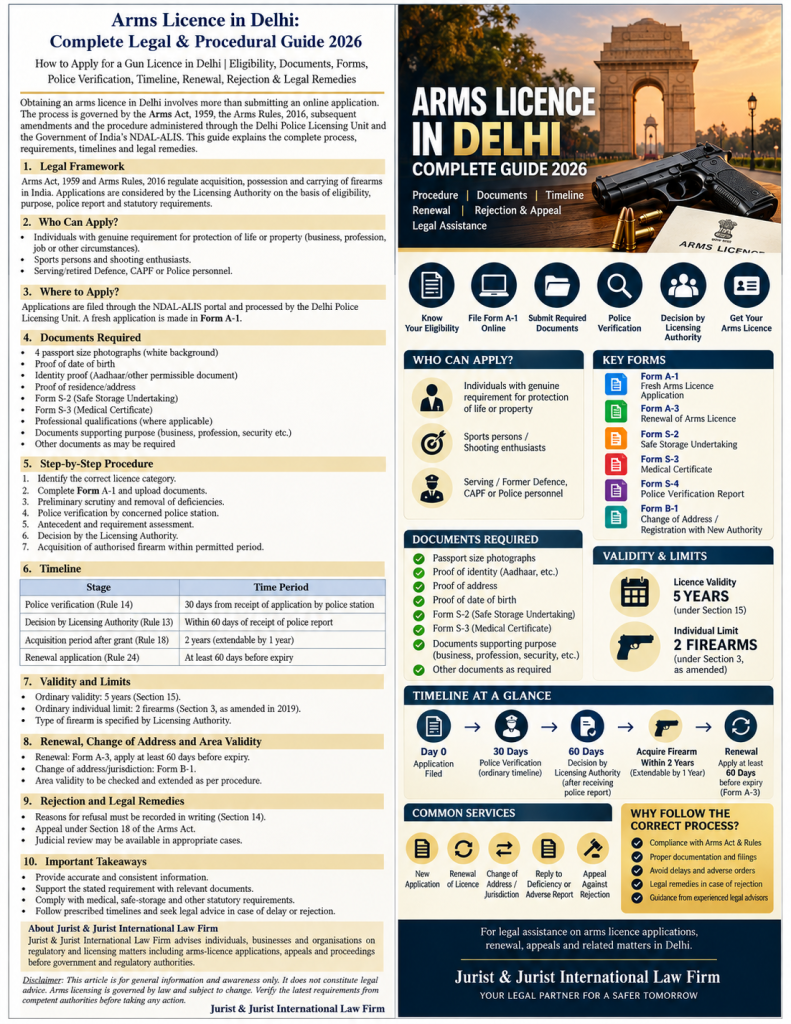
How to Apply for a Gun Licence in Delhi | Eligibility, Documents, Forms, Police Verification, Timeline, Renewal, Rejection & Legal Remedies
Obtaining an arms licence in Delhi involves much more than submitting an online application. The process is governed by the Arms Act, 1959, the Arms Rules, 2016, subsequent amendments and the procedures administered through the Delhi Police Licensing Unit and the Government of India’s NDAL-ALIS (National Database of Arms Licences – Arms Licence Issuance System).
An applicant may need to establish the genuine purpose for which the firearm is required, submit prescribed identity, medical and safe-storage documents, undergo police and antecedent verification, and satisfy the Licensing Authority regarding eligibility under the statutory framework.
This Delhi Arms Licence Information Hub explains the complete process—from filing a fresh application to renewal, change of address, refusal and legal remedies.
Quick Guide: Arms Licence in Delhi
| Particular | Requirement |
| Governing law | Arms Act, 1959 & Arms Rules, 2016 |
| Fresh individual application | Form A-1 |
| Common individual licence | Form III, depending upon category/purpose |
| Online platform | NDAL-ALIS |
| Delhi authority | Delhi Police Licensing Unit |
| Safe-storage undertaking | Form S-2 |
| Medical certificate | Form S-3 |
| Police verification report | Form S-4 |
| Ordinary police-report timeline | 30 days from receipt by concerned police officer |
| Licensing decision | Ordinarily within 60 days after receipt of police report, subject to Rule 13 |
| Renewal application | Form A-3 |
| Renewal filing | At least 60 days before expiry |
| Ordinary validity of Section 3 licence | 5 years, subject to the Act |
| Ordinary individual firearm ceiling | 2 firearms, subject to statutory exceptions |
| Appeal | Section 18, Arms Act |
1. What Is an Arms Licence?
An arms licence is a statutory authorisation permitting a person to acquire, possess, carry or otherwise deal with specified arms or ammunition subject to the category, conditions and territorial validity of the licence.
Possession of a firearm in India is regulated by law. Merely purchasing or possessing a firearm without the required statutory authority can have serious legal consequences.
For individuals in Delhi, the relevant licence depends upon the nature of the firearm, purpose and category of the applicant. A person considering a firearm licence should therefore first identify what licence is required and why it is required rather than beginning with the choice of firearm.
2. Who Can Apply for an Arms Licence in Delhi?
Eligibility cannot be reduced to a single formula such as having a clean criminal record. For an individual application involving permissible-category arms, Rule 12 of the Arms Rules, 2016 is particularly significant.
Among the circumstances contemplated under the Rules are applications concerning protection of life and/or property, sports shooting, and specified serving or former Defence, Central Armed Police Forces or State Police personnel, subject to the applicable statutory requirements.
For protection of life or property, the Rules contemplate a person who, because of the nature of his or her business, profession, job or otherwise, has a genuine requirement to protect life and/or property. The precise eligibility and supporting documents depend upon the category under which the application is made.
3. Is an Actual Threat to Life Compulsory?
An applicant relying upon protection of life or property should not assume that the law requires proof that an attack must already have occurred. Rule 12 refers more broadly to a genuine requirement arising because of the nature of the applicant’s business, profession, job or otherwise.
However, merely writing “self-defence” does not guarantee an arms licence. The Licensing Authority may examine whether the requirement stated is genuine and whether the statutory requirements are otherwise satisfied. The application should explain the actual circumstances clearly, accurately and consistently.
4. Where Do You Apply in Delhi?
Arms licensing in Delhi is administered through the Delhi Police Licensing Unit, while the Government of India’s NDAL-ALIS portal provides the national online arms-licensing framework.
For a fresh individual application, the relevant application is generally Form A-1—Application for grant of a new arms licence in Form II, Form III or Form IV, as applicable. For an ordinary individual applicant seeking a permissible-category firearm for possession/carrying, Form III is commonly relevant, subject to the exact nature and purpose of the licence.
5. Documents Required for a Fresh Arms Licence
Rule 11 of the Arms Rules deals with supporting documentation for applications. Depending upon the applicant and category, documentation may include the following:
- Four recent passport-size photographs with a white background;
- Proof of date of birth;
- Aadhaar or other permissible identity documentation in accordance with the Rules;
- Proof of residence/address, wherever applicable;
- Form S-2 – Safe Storage Undertaking;
- Form S-3 – Medical Certificate;
- Documents concerning professional qualifications, where relevant;
- Documents supporting the category and purpose of the application; and
- Other information/documents lawfully required by the Licensing Authority.
The documentation supporting the applicant’s stated requirement can be particularly important. If an application is based upon professional, business or security circumstances, the documents should correspond with what has actually been stated in the application.
6. What Is Form S-2?
Form S-2 concerns safe storage. An applicant is required to undertake that appropriate arrangements exist for securely storing the firearm so as to minimise the possibility of theft, misuse or unauthorised access. Safe custody is a continuing responsibility and should not be treated merely as paperwork.
7. What Is Form S-3?
Form S-3 is the prescribed medical certificate. Medical fitness forms part of the licensing framework. The certificate addresses relevant aspects of the applicant’s mental and physical fitness and matters concerning dependence upon intoxicating or narcotic substances.
8. Step-by-Step Procedure for Obtaining an Arms Licence in Delhi
The process can broadly be divided into eight stages:
- Step 1 — Identify the correct licence category and the purpose for which the firearm is required.
- Step 2 — Complete Form A-1 with accurate personal, residential, professional and other prescribed particulars.
- Step 3 — Upload/submit supporting documents including the applicable S-2 and S-3 documents.
- Step 4 — Preliminary scrutiny and rectification of any deficiency.
- Step 5 — Police verification by the concerned police machinery.
- Step 6 — Antecedent and requirement assessment, including further inquiry where lawfully considered necessary.
- Step 7 — Decision by the Licensing Authority after considering the police report, eligibility and relevant material.
- Step 8 — If granted, acquisition only of the authorised firearm and completion of applicable endorsement/registration requirements.
9. How Does Police Verification Work?
Under Section 13 of the Arms Act, the Licensing Authority calls for a report from the officer-in-charge of the nearest police station. Under Rule 14, the police report is furnished in Form S-4. Verification enables the authorities to consider relevant information concerning the applicant and the circumstances of the application.
10. How Long Does Police Verification Take?
Rule 14 provides that the officer-in-charge of the nearest police station is ordinarily required to send the report within 30 days from the date the application is received by that officer, subject to the statutory framework and applicable extensions/orders. The Rules also contemplate circumstances in which the Licensing Authority may proceed in accordance with law where the report is not received within the prescribed period.
11. What Is the Time Limit for Deciding the Application?
Under Rule 13, after receiving the police report and satisfying itself regarding fulfilment of the applicable eligibility conditions, the Licensing Authority is required to pass an order granting or refusing the relevant licence within 60 days of receipt of the police report.
These periods should not automatically be added together and represented as a guaranteed “90-day licence”. Actual processing may be affected by deficiencies, additional inquiries and other circumstances recognised by law.
12. What Factors Can the Licensing Authority Consider?
The authority may examine statutory eligibility, the category and purpose of the licence, genuineness of the stated requirement, nature of business/profession or other circumstances where relevant, police verification, antecedents, medical fitness, safe-storage arrangements, public peace and public safety considerations, and other statutory requirements. A clean criminal record is important but should not be confused with an automatic entitlement.
13. Can a Licence Be Refused Merely Because a Person Is Not Wealthy?
No. Section 14 of the Arms Act provides that a licence cannot be refused merely on the ground that the applicant does not own or possess sufficient property. Financial status by itself is therefore not the statutory test.
14. Can the Authority Decide What Type of Firearm May Be Purchased?
Yes. Under the applicable Rules, the Licensing Authority may specify the type of arms and ammunition that may be procured after considering the applicant’s reasons, need and the nature/lethality of the firearm. Applying for a particular firearm does not create an automatic entitlement to that firearm.
15. How Long Do You Get to Purchase a Firearm After Grant?
Under Rule 18, where the licence concerns a firearm yet to be acquired, the Licensing Authority ordinarily allows the licensee two years to acquire it. Upon written representation and for recorded reasons, an extension of a further one year may be granted in accordance with the Rule.
16. How Many Firearms Can One Person Legally Keep?
The Arms (Amendment) Act, 2019 amended Section 3. The ordinary statutory ceiling for an individual is now two firearms, subject to the exceptions and other provisions of the Act. Older material referring generally to three firearms may therefore be outdated.
17. What Is the Validity of an Arms Licence?
Following the 2019 amendment, Section 15 provides that a licence issued under Section 3 ordinarily continues for five years from the date on which it is granted, unless revoked earlier. A shorter validity may apply where requested by the licensee or where the Licensing Authority records reasons for granting a shorter period.
18. How to Renew an Arms Licence in Delhi
The prescribed application for renewal of an individual licence is generally Form A-3. Under Rule 24, the renewal application should ordinarily be submitted at least 60 days before expiry. Waiting until the licence is about to expire can create avoidable complications.
19. What Happens If an Arms Licence Expires?
An expired licence should never be treated casually where a firearm remains in possession. The consequences and procedure depend upon the applicable statutory provisions, licence conditions and circumstances. Where the licence has already expired, appropriate advice should be obtained regarding lawful custody/deposit and renewal/restoration, as applicable.
20. What If You Change Your Address?
Where a Form III licensee permanently changes residence—or temporarily relocates for more than six months—to a place outside the jurisdiction of the existing Licensing Authority and carries the licensed firearm, the prescribed registration procedure with the new authority becomes applicable. The relevant application is Form B-1.
21. Can an Arms Licence Be Valid Throughout India?
Area validity is a separate matter from grant of the licence itself. The licence document and applicable permissions must be examined to determine the geographical area within which it operates. Where extension is required, the prescribed process must be followed.
22. Common Reasons an Application May Face Difficulty
- Incomplete documentation;
- Inconsistency in information supplied;
- Inability to substantiate the stated requirement;
- Adverse material during police verification;
- Statutory disqualification;
- Medical-fitness concerns;
- Public peace/public safety considerations;
- Incorrect licence category;
- Suppression of material facts;
- False or inaccurate information; or
- Failure to comply with procedural requirements.
23. What Happens If Delhi Police Rejects an Application?
Under Section 14 of the Arms Act, reasons for refusal are required to be recorded in writing. Subject to the statutory exception concerning public interest, the applicant may seek a brief statement of those reasons. The refusal order should be examined against the Arms Act, Arms Rules, police report, material filed and the reasons recorded.
24. Is There an Appeal Against Rejection?
Yes. Section 18 of the Arms Act provides the statutory appellate mechanism against specified orders passed by licensing authorities. The Arms Rules further regulate the appellate procedure. The limitation period and prescribed procedure should be checked immediately after receiving the order.
25. Can You Approach the High Court?
Judicial review may become relevant in an appropriate case, particularly where there is alleged illegality, procedural unfairness, failure to exercise statutory jurisdiction or prolonged unexplained inaction. The existence of a statutory appellate remedy is an important consideration. A direction to decide an application according to law is distinct from a direction to grant a licence.
26. What Can Be Done If the Application Is Pending for Months?
The first step is to identify exactly where the application is pending: whether police verification is pending, the police report has been submitted, a deficiency has been communicated, further documentation is required, or the matter awaits consideration by the Licensing Authority. Where requirements have been completed but the application remains undecided beyond the applicable period, a documented representation may be appropriate; further remedies depend upon the facts.
27. How Should a Strong Application Be Prepared?
The strength of an application should come from facts and documentation—not exaggerated language. The applicant should clearly identify who the applicant is, why the licence is required, what documents support the circumstances, whether all statements are consistent, and whether all statutory documents have been properly completed.
28. Arms Licence Forms: Quick Reference
| Form | Purpose |
| Form A-1 | Fresh individual arms licence application |
| Form A-3 | Renewal of individual arms licence |
| Form B-1 | Registration with another Licensing Authority/change of jurisdiction |
| Form S-2 | Safe-storage undertaking |
| Form S-3 | Medical certificate |
| Form S-4 | Police verification report |
29. Arms Licence Timeline in Delhi – At a Glance
- Day 0 — Application filed with prescribed documents.
- Police Verification — ordinarily 30 days from receipt by the concerned police officer, subject to the statutory framework.
- Police Report — forwarded to the Licensing Authority.
- Licensing Authority — application, police report and eligibility considered.
- Decision — Rule 13 ordinarily contemplates an order within 60 days of receipt of the police report.
- If Approved — licence/acquisition authorisation issued subject to applicable conditions.
- Acquisition — authorised firearm acquired within the permitted period and appropriately endorsed.
- Renewal — apply in Form A-3 at least 60 days before expiry.
Frequently Asked Questions – Arms Licence Delhi
Can I apply online for a gun licence in Delhi?
The Government’s NDAL-ALIS platform provides online arms-licensing services, including the prescribed service for a fresh individual licence. Applicants should follow the current Delhi Police/NDAL procedure applicable when the application is made.
Which form is required for a new arms licence?
A fresh individual application is generally made through Form A-1, seeking the appropriate licence in Form II, III or IV depending upon the case.
Is police verification compulsory?
Police reporting forms an integral part of the statutory process under Section 13 and Rule 14, subject to the provisions dealing with situations where the report is not received within the prescribed period.
How long does police verification take?
The ordinary period prescribed under Rule 14 is 30 days from receipt of the application by the officer-in-charge of the nearest police station, subject to applicable extensions/orders.
Is a criminal case an automatic bar?
The answer depends upon the precise facts, nature and status of proceedings and the statutory provisions involved. Required information should not be suppressed.
Can an arms licence be obtained simply for self-defence?
Merely using the expression “self-defence” does not create an automatic entitlement. The Licensing Authority considers the genuine requirement and applicable statutory criteria.
How long is an arms licence valid?
A licence under Section 3 ordinarily remains valid for five years, subject to Section 15 and any shorter period lawfully specified.
How many firearms can an individual possess?
The ordinary statutory ceiling is two firearms, subject to applicable exceptions.
Can I appeal if my licence is rejected?
The Arms Act provides an appellate remedy under Section 18 against specified orders.
Legal Takeaway
The procedure for obtaining an arms licence in Delhi combines administrative processing with substantive legal scrutiny. An applicant must complete the appropriate application, satisfy the Arms Act, 1959 and Arms Rules, 2016, undergo police verification, comply with medical and safe-storage requirements and establish the genuine purpose relevant to the category sought.
Equally, licensing authorities exercise statutory—not unlimited—powers. The law prescribes procedures and timelines, requires decisions according to the governing legislation and provides appellate and judicial remedies in appropriate cases. The safest approach is to ensure that the application is factually accurate, legally structured, adequately documented and consistent from initial filing through final consideration.
Legal Assistance for Arms Licence Matters in Delhi
Jurist & Jurist International Law Firm advises on regulatory, licensing and administrative-law matters in Delhi and other jurisdictions. Legal assistance may include review of proposed applications, eligibility assessment, documentation, representations concerning delay, examination of adverse police reports, replies before the Licensing Authority, appeals against refusal, renewal/address issues and appropriate judicial proceedings.
For detailed legal insights, regulatory updates and practical guides, visit the Knowledge Center of Jurist & Jurist International Law Firm.
Disclaimer: This publication is intended solely for general legal information and public awareness. It does not constitute legal advice, solicitation or an encouragement to acquire, possess or use a firearm. Arms licensing is governed by the Arms Act, 1959, Arms Rules, 2016, amendments, notifications, judicial decisions and directions issued by competent authorities from time to time. Current requirements should be verified from the competent authority before taking any action.