
MP High Court Condoned 1,093 Day Delay After Lawyer Failed to Advise Client
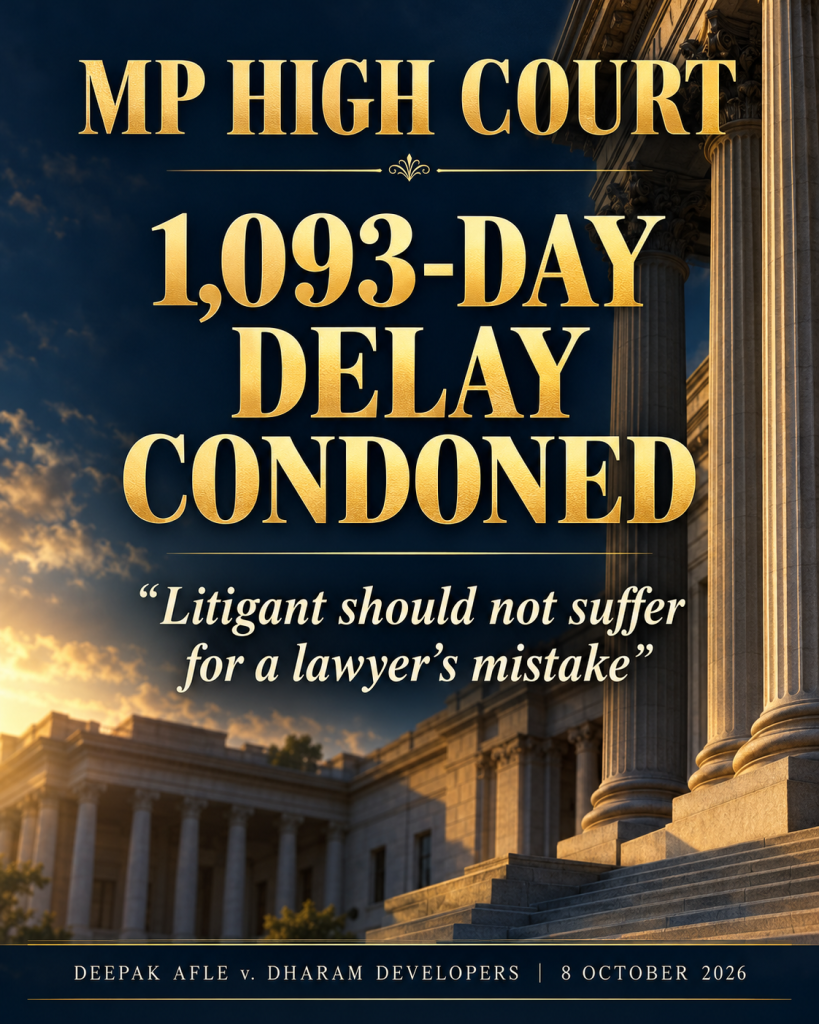
When a lawyer’s mistake delays a challenge to an ex parte decree
Can a litigant lose the opportunity to challenge an ex parte decree because the lawyer engaged by them failed to advise them about the appropriate remedy?
In Deepak Afle v. Dharam Developers and Finvest Limited, the Madhya Pradesh High Court at Indore answered that question in the context of an application filed 1,093 days late. The Court held that, on the facts before it, the litigant should not suffer for the lawyer’s failure to advise him to seek setting aside of the ex parte decree. It therefore condoned the delay, subject to payment of costs, and restored the application for the trial court to decide on its merits.
| Case | Deepak Afle v. Dharam Developers and Finvest Limited & Others |
| Court | Madhya Pradesh High Court, Indore Bench |
| Case number | Civil Revision No. 514 of 2025 |
| Neutral citation | 2026:MPHC-IND:28413 |
| Decision date | 8 October 2026 |
Background of the dispute
The dispute concerned a suit for specific performance of an agreement to sell land. The plaintiff company claimed that the landowner had agreed to sell the property and had received ₹10 lakh towards the sale consideration.
After the summons were returned unserved, the trial court permitted substituted service through newspaper publication. The defendant did not appear, and the court proceeded ex parte. On 8 August 2019, it passed an ex parte decree for specific performance and permanent injunction.
The defendant said he first learned of the decree when he received notice in execution proceedings in November 2019. He engaged a lawyer, who appeared in the execution matter but, according to the defendant, did not advise him to apply under Order IX Rule 13 of the Code of Civil Procedure to set aside the decree. In July 2022, the defendant learned that the lawyer had moved to Kerala. After consulting another lawyer, he filed an Order IX Rule 13 application, together with an application under Section 5 of the Limitation Act seeking condonation of delay.
The trial court rejected the request to condone the 1,093-day delay. The District Court upheld that decision. The defendant then approached the High Court in civil revision.
What the High Court decided
The High Court set aside the orders of the trial court and the District Court and condoned the delay, subject to the defendant paying ₹50,000 in costs to the plaintiff.
The Court did not set aside the ex parte decree. It restored the Order IX Rule 13 application to the trial court, which must now decide that application in accordance with law and without being influenced by the High Court’s observations.
That distinction matters: condoning delay allowed the defendant’s application to be heard. It did not determine whether the decree should ultimately be set aside.
Why the delay was condoned
The High Court considered the explanation that the defendant had relied on the lawyer who appeared for him in the execution proceedings. The lawyer did not advise him to seek relief against the ex parte decree, and the defendant approached another lawyer after learning that the earlier lawyer had shifted.
The Court treated the explanation in light of the case’s circumstances, including the defendant’s reliance on legal advice and the serious consequences of leaving the decree unexamined. It also considered the COVID-19 limitation-extension directions of the Supreme Court, which excluded the period from 15 March 2020 to 28 February 2022 from the computation of limitation.
Relying on the principle in N. Balakrishnan v. M. Krishnamurthy, the High Court reiterated that the acceptability of the explanation is central to deciding whether delay should be condoned; the length of delay is not the only consideration. A short delay may be refused if it is not properly explained, while a longer delay may be condoned if the explanation is acceptable.
A case-specific ruling, not an automatic exemption
The decision does not mean that a lawyer’s mistake will automatically excuse every delay. A court still examines the explanation, the surrounding facts and the litigant’s conduct. In this case, the High Court considered the defendant’s explanation, his reliance on the lawyer, the COVID-19 period and the consequences of refusing to hear the application.
The ruling is therefore best understood as a reminder that delay-condonation applications require a reasoned assessment of the particular circumstances. The number of days matters, but it does not replace that assessment.
Practical lessons for litigants and lawyers
For litigants, the case underlines the importance of asking promptly what steps are available after learning of an ex parte decree, particularly when execution proceedings begin. A party seeking condonation should set out a clear chronology and support the explanation with relevant material wherever possible.
For lawyers, the decision reinforces the importance of explaining available remedies and limitation periods clearly, recording advice and maintaining continuity when a matter is transferred or counsel becomes unavailable.
For courts, the judgment underscores that a delay application should be assessed on its explanation and surrounding facts rather than disposed of solely by counting the days.
Conclusion
In Deepak Afle, the Madhya Pradesh High Court gave the litigant an opportunity to have his Order IX Rule 13 application heard despite a 1,093-day delay. It did so on the facts of the case, with ₹50,000 in costs and with the trial court still required to decide whether the ex parte decree should be set aside.
The ruling does not undo the decree. It restores the opportunity to challenge it through the appropriate application.
Disclaimer: This article is for general legal information and is not a substitute for advice based on the facts and procedural record of a particular matter.
Source: Madhya Pradesh High Court, Civil Revision No. 514 of 2025, neutral citation 2026:MPHC-IND:28413. Read the order